CFD Trading for Beginners in Singapore: Choose a Platform, Try a Demo & Start With Confidence


CFD trading has become both a lucrative side hustle and a main source of income for financially conscious individuals around the world. It can be done online, the markets can be accessed wherever you are, and with the right strategy, traders can consistently build portfolio growth.
Our guide will help you get started with CFD trading. Here’s what you’ll need to know before you make your first trade. You’ll need to choose a CFD broker in Singapore, a compatible platform, and get a feel for paper trading if you want to get started.
Key Takeaways
- CFD trading allows you to speculate on price movements of global assets like Forex, stocks, and commodities without actually owning them.
- CFD trading gives you the ability to “go short,” which means you can profit from falling markets just as you would rising ones.
- Leverage enables you to control large positions with a small deposit, increasing your gains as if you held those positions, but it also significantly increases your losses.
- A demo account is a vital, risk-free sandbox for learning platform mechanics, though it cannot replicate the emotional pressure of live trading.
- Transitioning to a live account requires a proven track record of consistency, habitual use of stop-loss orders, and disciplined risk management.
What is CFD Trading
When you trade a Contract for Difference (CFD), you enter into an agreement to exchange the difference in the price of an asset from when you open the position to when you close it.
You do not own the underlying share, currency pair, or commodity. Instead, you speculate on whether the price will go up or down. Correct speculations on the market trend will earn you gains; whereas if the market moves against you, you incur a loss.
As such, traders typically rely on widely accepted strategies, such as support and resistance and on historical market movement to make consistent predictions.
Sustainably managing risk and wrong moves is crucial to finding growth with CFD trading, since a lot of emotion and mental drain can be involved.
Markets Commonly CFD Traded
There are various markets that can be traded with CFDs. Each market has its own characteristics and reacts differently to global news.
Forex
Forex, or foreign exchange, is the world’s largest financial market. When you trade Forex CFDs, you are speculating on the value of one currency against another. For example, if you believe the British Pound will strengthen against the US Dollar, you might trade the GBP/USD pair.
The Forex market operates 24 hours a day, five days a week.
Stocks
Stock CFDs allow you to trade the price movements of major companies listed on global exchanges like the NYSE, NASDAQ, or the ASX. You might want to trade tech giants or retail leaders. Instead of buying a single share and holding it for years, you can use CFDs to profit from short-term price fluctuations.
One advantage of trading stocks via CFDs is the ability to go short.
In traditional stock investing, you generally only make money if the company’s value increases. When you CFD trade stocks, you can enter a “sell” trade—even if you haven’t previously bought—if you think a company’s stock price is going to fall, allowing you to profit from downward trends.
Indices
An index represents a group of stocks from a particular exchange. For instance, the S&P 500 tracks the 500 largest companies in the US. When you trade an index CFD, you are trading on the overall performance of a sector or an entire economy rather than a single business.
This is a popular choice for traders who prefer to look at the big picture. You might follow news regarding interest rates or national employment figures, as these events tend to move entire indices at once.
Crypto
Cryptocurrency CFDs have become a staple for traders looking for volatility. The prices of assets like Bitcoin or Ethereum can move significantly in a single hour or day.
You can speculate on the price of crypto against the US Dollar or other fiat currencies. Be wary of the crypto space, however, as subcommunities within it can be filled with gurus and lifestyle-preying influencers.
Spot Metals
Trading spot metals like Gold and Silver is a common strategy for those looking to hedge against inflation or economic uncertainty. Gold is often viewed as a safe-haven asset. When markets are volatile or geopolitical tensions rise, many traders flock to Gold.
By trading metals as CFDs, you avoid the costs associated with storing physical bars or coins. You get the same exposure to the metal’s price, with the benefit of instant execution and the ability to use leverage.
Energies
The energy market primarily revolves around Oil and Natural Gas. These commodities are highly sensitive to global supply and demand, as well as political decisions made by major producing nations.
When supply is short, energy prices often rise. Conversely, a global economic slowdown, resulting in slower production and less leisure travel, can lead to lower prices.
How Do People Earn from CFD Trading?
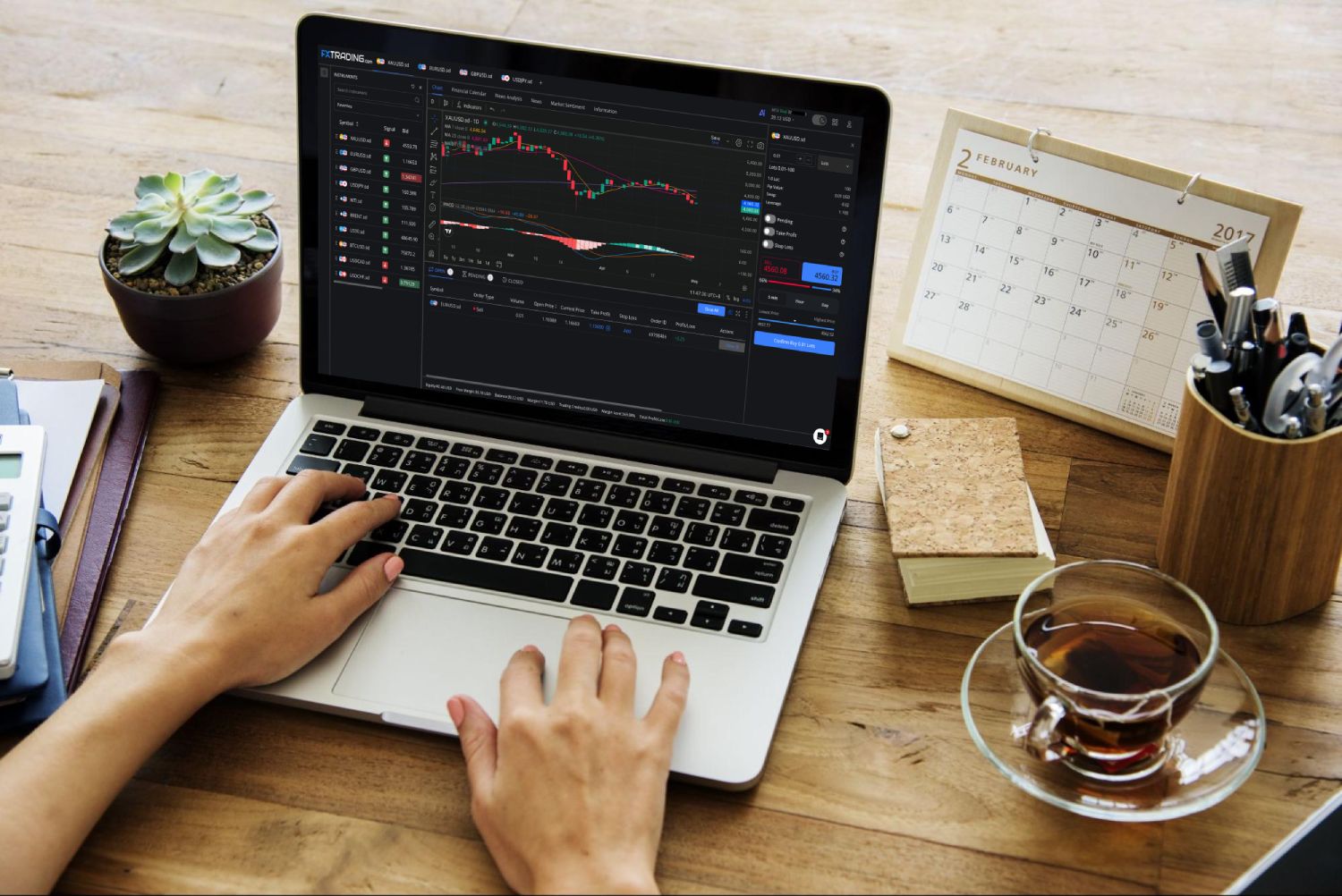
The logic behind earning in CFD trading is straightforward: you aim to profit from the price change of an asset. There are two ways to do this.
- If you think the price will rise, you “Buy” (go long). If the price increases and you close the position, you earn the difference between the opening and closing prices. If the price falls, you lose that difference.
- If you think the price will fall, you “Sell” (go short). You earn a profit if the price is lower when you close the trade than when you opened it. If the price rises while you are in a short position, you incur a loss.
Your profit or loss is calculated by multiplying the price difference by the size of your position. Because we provide leverage, your gains and losses are calculated based on the full value of the trade, not just the margin you put up. This is why risk management is essential.
How to Get Started with CFD Trading
Here’s how you can get started with CFD trading:
Choose a Broker
Your first step is to select a regulated, reliable partner.
A CFD Broker in Singapore acts as the intermediary between you and the financial markets. Unlike a traditional stockbroker, who helps you buy and own a physical share of a company, a CFD broker facilitates a contract in which you exchange the difference in the price of an asset from when you open the trade to when you close it.
Your broker also determines the following:
- The leverage you can use. Brokers can provide you with leverage, allowing you to control a large market position with a relatively small initial deposit. Your broker sets the specific leverage ratios (e.g., 10:1 or 30:1), which can magnify both your potential profits and your potential losses.
- The markets you have access to. The broker serves as your gateway to a range of global asset classes. Depending on the broker’s offerings, you can speculate on the price movements of thousands of instruments, including international stocks, forex pairs, major indices, and commodities such as oil and gold.
- Any operating fees you’ll have to pay. Brokers structure the costs of your trades, which typically include the spread (the gap between the buy and sell price), commissions, and any withdrawal fees.
Choose a Trading Platform
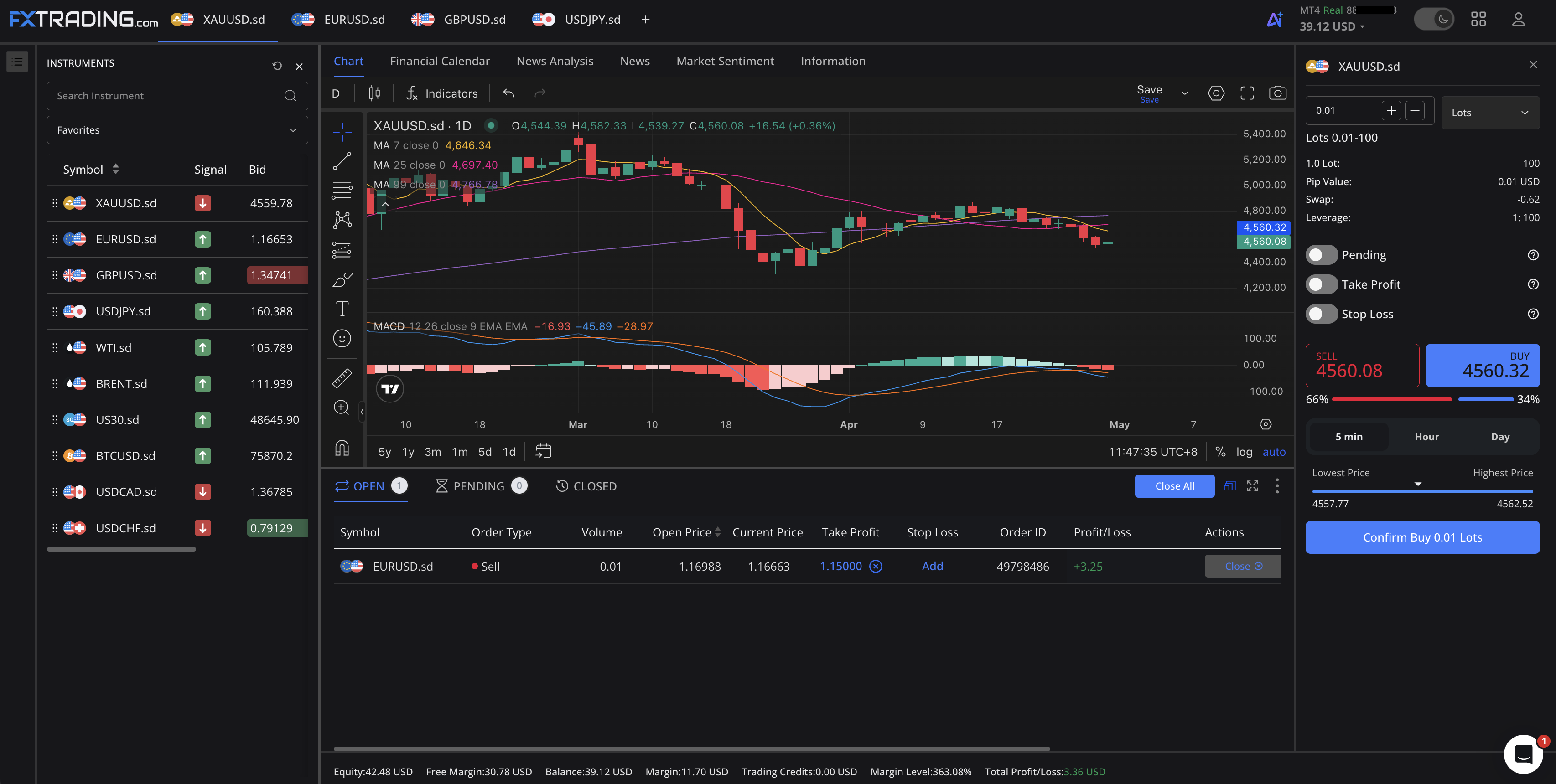
The platform is the software you use to place your trades, view charts, and analyse the markets. These tools are designed to give you all the technical indicators and charting tools you need. It’s also where you place your Buy & Sell orders.
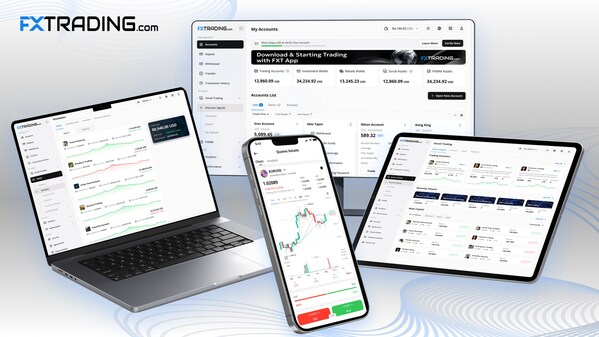
Some brokers will have their own proprietary trading platform. For example, here at FXTRADING.com, we can be accessed through our FXT Trading App and the FXT WebTrader, which is a browser-based platform.
Other brokers offer access through popular third-party platforms, such as MetaTrader 4 and 5. Here at FXT, users can access their portfolio through both our proprietary platform and MetaTrader.
A good platform should be stable and accessible on both desktop and mobile devices. This ensures you can monitor your positions wherever you are.
The platform should also be optimised so that it isn’t sluggish or clunky to use.
Open a Demo Account
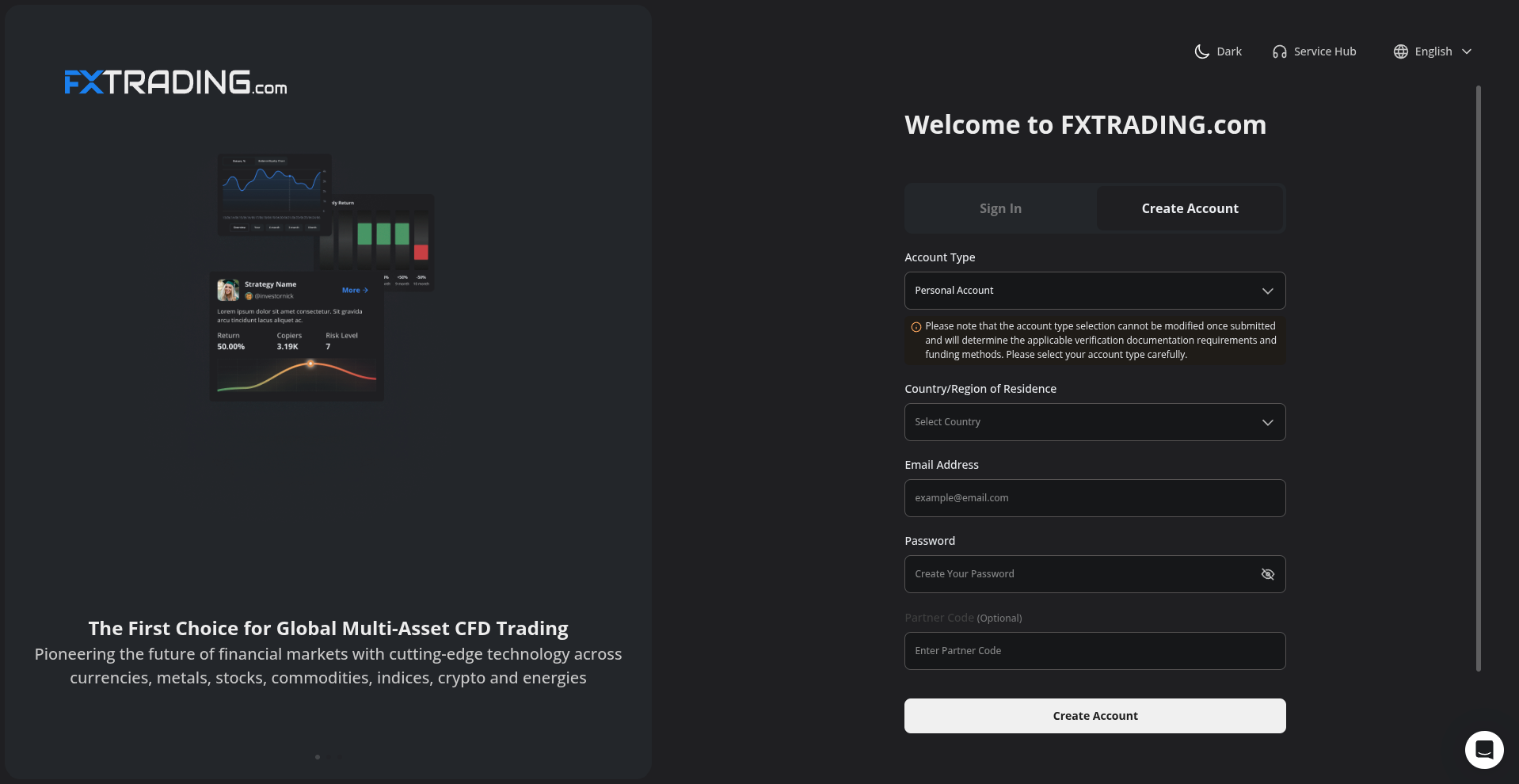
We highly recommend that every beginner start with a demo account. This is a practice environment where you use virtual funds instead of real money. It looks and feels exactly like a live trading environment, but there is no financial risk to you.
A demo account is your sandbox. It is where you learn to navigate the platform and trade. You can experiment with different strategies without the fear of losing your savings.
Begin Paper Trading
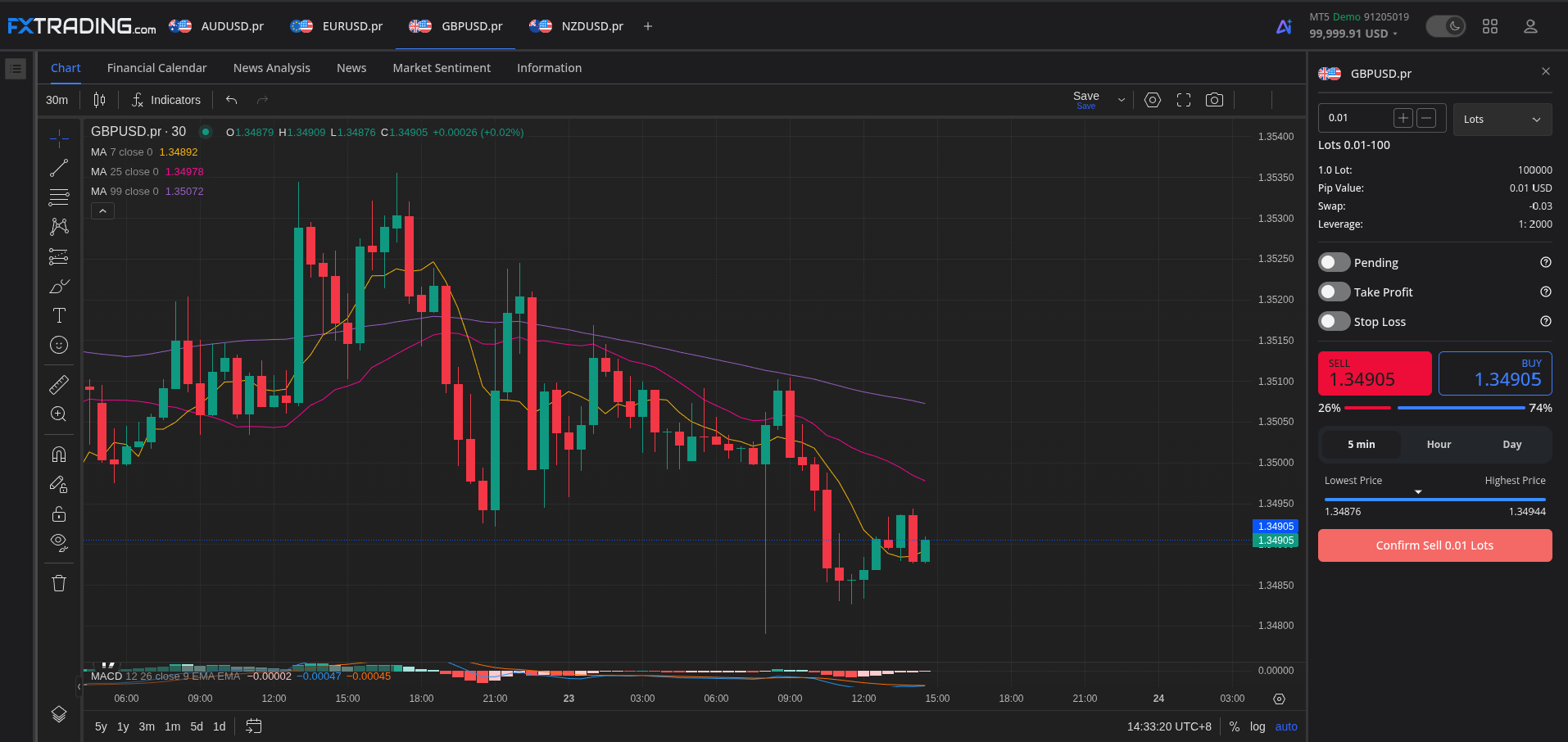
Paper trading is the act of using your demo account to simulate real trading. You should treat your virtual balance as if it were real money. This means you should only take trades that you would actually take with your own capital.
During this phase, your goal is to learn the mechanics. You will see how the news affects price charts in real-time. You will learn how to calculate your position size so you don’t risk too much of your virtual “capital” on a single trade. This practice period is vital for building familiarity with live trading.
What to Keep In Mind when Using a Demo Account
While a demo account is an excellent tool, it is not an exact replica of the live trading experience. You must be aware of its limitations so you do not develop bad habits.
You Have Unlimited Allowance With a Demo Account
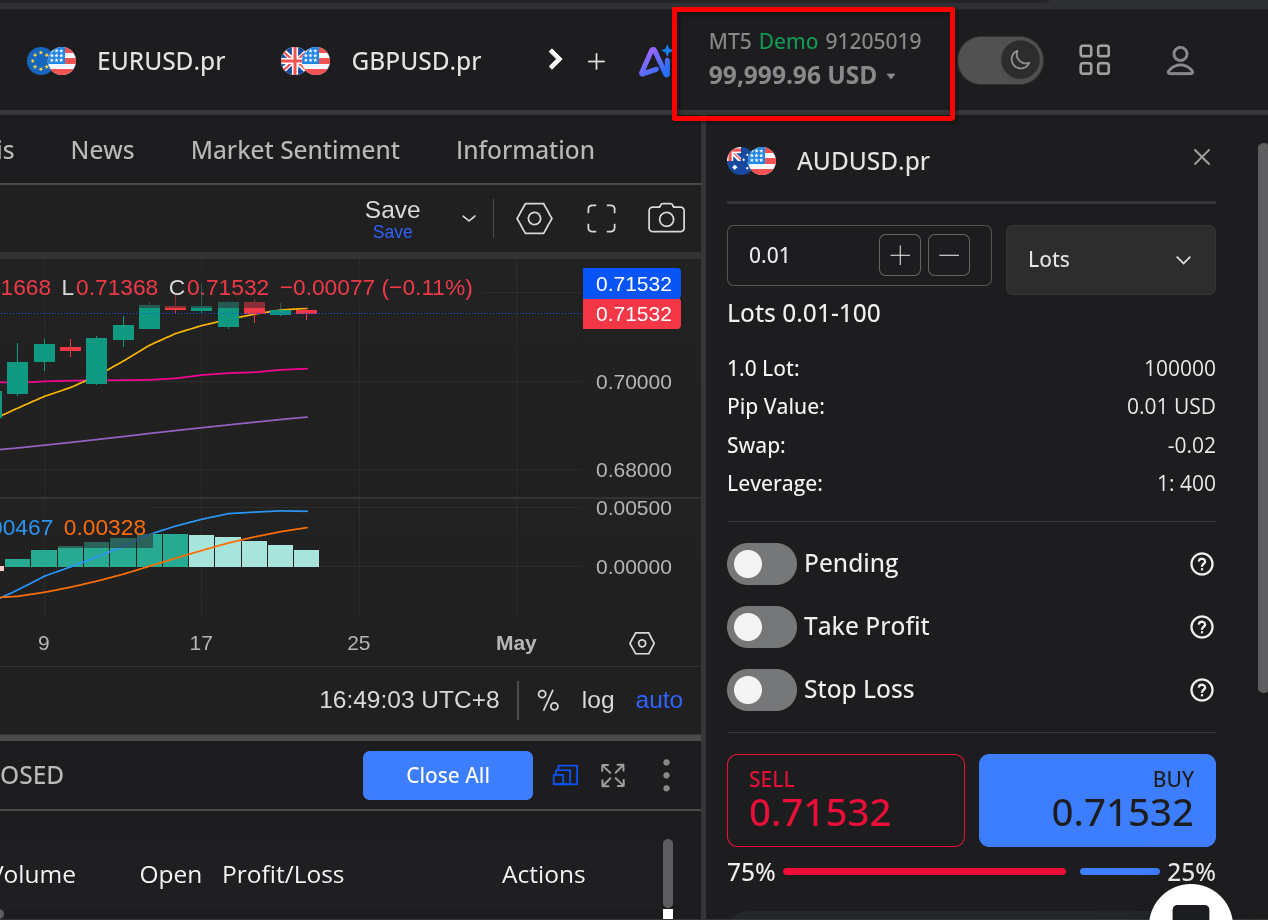
One of the biggest traps for beginners is the fact that virtual money is infinite. In a demo environment, you might start with a virtual balance of $100,000. If you make a mistake and lose $1,000, you might not care because it is just virtual currency. You might even see your account dip significantly, only for the market to eventually turn around and put you in a $2,000 profit.
In reality, if you only had $1,000 of real money in your account, that initial loss would have wiped you out. Your account would be closed before the market ever had a chance to bounce back into profit.
This creates a false sense of security. You must trade on the demo account using the same balance you plan to start with in real life.
You’ll Always Win With a Demo Account
Because there is no consequence to losing, many traders stay in losing positions much longer than they should. They wait and wait until the price eventually moves back in their favour. Because the demo account has no margin, it doesn’t hurt their real-world wallet, so they feel like they can’t lose.
This leads to the impression that you are a master trader because your “win rate” is high.
However, this success is often built on the back of staying in the red for days or weeks—something you could never afford to do with a real $500 or $1,000 account. You must learn to exit a trade when it goes against you, rather than waiting for a miracle.
The Trading Psychology is Much Different from Live Trading
The biggest difference between demo and live trading is your mind. When there is no real money on the line, you are calm. You can make logical decisions based on the charts. You aren’t worried about how a loss will affect your ability to pay your bills.
Once you move to live trading, every tick of the price chart feels different. You might feel a rush of adrenaline when you are winning or a pit in your stomach when you are losing.
This emotional response can lead to revenge trading, wherein you make a hasty trade after a loss, or perhaps you close a winning trade too early out of fear.
A demo account cannot teach you how to handle these feelings; it can only teach you the technical steps.
When Should You Move Into Live Trading?
Moving from a demo account to a live account is a big step. You should only do it when you have met certain criteria that prove you are ready for the responsibility of managing real capital.
When You’re Able to Gain Consistent Profits
Winning one big trade does not mean you are ready. Anyone can get lucky once. You are ready when you can show a history of trades over several weeks or months that result in a steady upward curve in your account balance.
Consistency is about following your plan every single day. It means you aren’t gambling; you are following a repeatable process. If your demo account shows that you are making a small, steady profit over a long period, you have demonstrated that your strategy has merit.
When Your Trades Aren’t Going Into the Red
You must reach a point where your entries are timed well enough that your trades do not immediately go far against you. If every trade you take spends three days in a massive loss before turning into a tiny profit, you aren’t ready.
You want to reach a stage where you are entering trades at points where the market moves in your direction relatively quickly, showing that you understand support, resistance, and momentum.
When You’ve Learned to Set Take-Profits and Stop Losses
You should never enter a live trade without knowing exactly where you will exit if you are wrong and where you will exit if you are right.
A Stop Loss is an order that automatically closes your trade at a set price to prevent further losses.
A Take Profit closes your trade once you have reached your target gain.
If you are still manually watching the screen and waiting to click the close button, you aren’t ready for live trading. You must have the discipline to set these levels and let the market do its work. This is both responsible trading and financing.
When You’ve Learned to Mitigate Risk to a Few Dollars
A common mistake for beginners is risking their entire account on one trade. You are ready for live trading when you understand how to calculate your position size so that a single losing trade only costs you a small percentage of your account—perhaps just a few dollars.
By keeping your risk per trade low, you ensure that a string of losses won’t end your trading career. This approach allows you to stay in the game long enough to learn and grow.
If you are only risking 1% or 2% of your balance per trade, you are thinking like a long-term trader.
When You’ve Built the Emotional and Psychological Readiness
Finally, you must mentally prepare yourself for the fact that you will lose money. Every trader, even the most successful ones, has losing trades. It is part of the cost of doing business.
You are ready when a loss doesn’t ruin your day, and a win doesn’t make you feel invincible. You should view trading as a series of probabilities. If you can stay calm, stick to your rules, and accept the outcomes without emotional volatility, you are ready to open a live account.
CFD Trade with FXTRADING.com Today!
We are here to support your growth as a trader. Once you have practised on our demo account and felt the rhythm of the markets, we invite you to take the next step.
At FXTRADING.com, we provide the platform, the assets, and the environment you need to trade. You can access FXT through our proprietary platforms or through MetaTrader, allowing you to trade wherever you are and on any device.
We also give you access to a wide range of CFD markets. Forex CFD, Stocks CFD, Indices CFD, Crypto CFD, Spot Metals CFD and Energies CFD. So that you can diversify your portfolio, and jump into other markets should one stagnate.
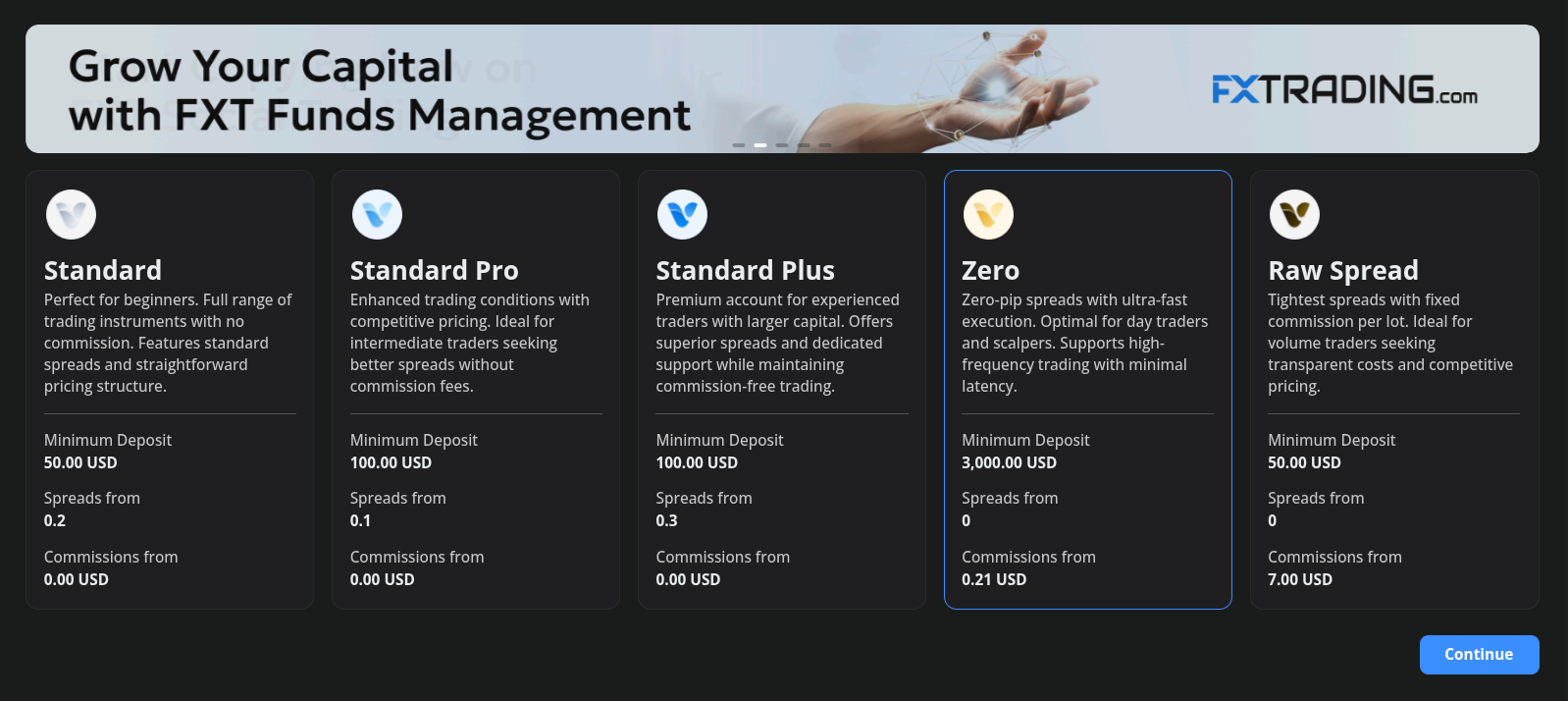
You can get started with FXT for as little as a 50 USD deposit. With this, you already have access to a 2000:1 leverage. Join us today and see why so many traders choose our platform for their CFD needs.
Frequently Asked Questions
What is the “spread” in CFD trading?
The spread is the difference between the buy and sell prices of an asset. It essentially represents the cost of entering the trade and is how brokers often earn their revenue.
What is the difference between a Market Order and a Limit Order?
A Market Order executes your trade immediately at the current price, while a Limit Order only opens your trade if the asset reaches a specific price you have pre-determined.
What is a Margin Call?
A margin call occurs when your account equity falls below the broker’s required minimum to keep your positions open, often prompting a request to deposit more funds or the automatic closure of your trades.
Can I receive dividends when trading Stock CFDs?
Generally no. You don’t own the underlying shares, so you won’t receive dividends. However, some brokers will make a price adjustment to your CFD account that reflects the dividend value if you hold a long position on the ex-dividend date. But most of your profits from stock CFDs would be made by making correct predictions on longs and shorts.