How Do I Start Forex Trading as a Beginner? Everything You Need to Know

Forex, or foreign exchange, is the exchange of various currencies against one another. You’ve likely seen financial forecasts of the Singapore Dollar against the US Dollar. Due to the fluctuating nature of currencies, keen-eyed individuals can buy certain currencies and then exchange them at opportune times for profit.
This is known as Forex Trading. It’s become a secondary hustle for enterprising individuals with day jobs around the world.
This guide will walk you through how to get started with Forex trading, and equip you with what you need to know to place your first trade.
Key Takeaways
- Forex trading is the simultaneous buying and selling of currency pairs to profit from fluctuations in global exchange rates.
- The market operates 24 hours a day, five days a week, with the highest activity occurring during session overlaps like London and New York.
- To trade effectively, you need a broker, a trading platform like MT4/MT5, and a charting program to analyse price trends.
- Risk management is vital, necessitating the use of stop-loss orders and the 1% rule to protect your capital from significant losses.
- Beginners should start with a demo “paper trading” account to practice strategies like moving averages and support/resistance without financial risk.
What is Forex Trading?
Forex trading involves the simultaneous buying of one currency and selling of another. You are essentially betting on the value of one nation’s currency against another.
At FXTRADING.com, we facilitate these exchanges through currency pairs. You will always see currencies listed in pairs, such as GBP/USD or EUR/JPY.
The first currency in the pair is the base currency, and the second is the quote currency.
If you buy the GBP/USD pair, you are buying British Pounds and selling US Dollars.
You do this because you believe the Pound will grow stronger compared to the Dollar.
The Forex market is the largest financial market on the planet, seeing trillions of dollars in daily turnover. It operates through a global network of banks and financial institutions rather than a central exchange.
How do you earn from Forex Trading?

Let’s say you have a ten-dollar note. But the shops where you are only take “Gold Coins.” You go to a shop and swap your ten dollars for ten Gold Coins.
The next day, everyone suddenly wants those Gold Coins, so they become more valuable. You go back to the shop and swap your ten Gold Coins for dollars, but this time, the shopkeeper gives you fifteen dollars! You started with ten dollars and ended with fifteen. That extra five dollars is your profit.
In the Forex market, we do the same thing but with money from different countries. We help you swap your money for another kind when you think it will become worth more later. When you swap it back, you hope to have more money than you started with.
The profit comes from the change in exchange rates between two currencies. You aim to buy a currency pair when the price is low and sell it when the price rises. This is known as “going long.”
Conversely, you can sell a pair if you believe the base currency will lose value, then buy it back later at a lower price. This is known as “going short.”
We measure price movements in “pips,” which stands for Percentage in Points. For most pairs, a pip is the fourth decimal place (0.0001). If the EUR/USD moves from 1.0850 to 1.0851, it has moved one pip. Even small movements in pips can lead to gains or losses.
What time do the forex markets open in Singapore?
The forex market is open 24 hours a day, five days a week. In Singapore time (SGT), the market typically opens at 5:00 AM on Monday and remains open until 5:00 AM on Saturday.
The market follows the sun across the globe. It starts with the Sydney session, followed by Tokyo, London, and finally New York.
The most active times for you to trade in Singapore occur when sessions overlap. For example, the London and New York overlap happens in the evening for Singapore-based traders. This period usually offers the most movement and liquidity because the two largest trading centres are active at the same time. You will find that trading during these windows provides more opportunities for price action.
What You Need to Get Started with Forex Trading
Before you begin trading, you’ll need the following tools:
Chart and Market Analysis Program
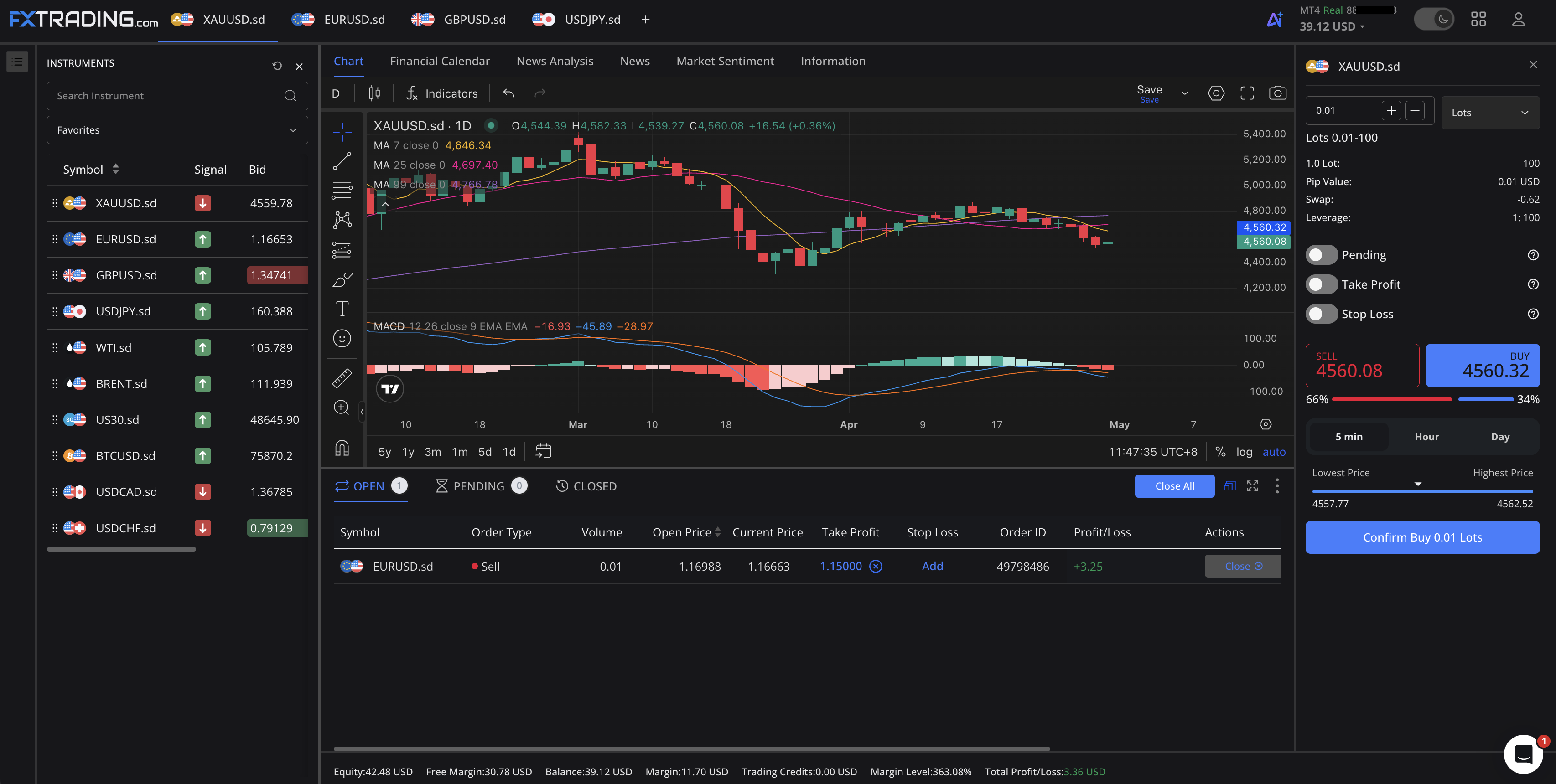
You need a way to look at price history and predict future movements. A chart analysis programme allows you to see the price action of currency pairs over different timeframes, such as one minute, one hour, or one day. These charts allow you to see a currency pair’s trend, and give you information about whether the trend will go up or down.
These programmes provide the visual data you need to make informed decisions. You can use these tools to identify patterns and historical price levels.
For beginners, however, the trading platform’s built-in charting function will already suffice. However, more advanced traders may want the utility of dedicated charting programmes.
Trading Platform
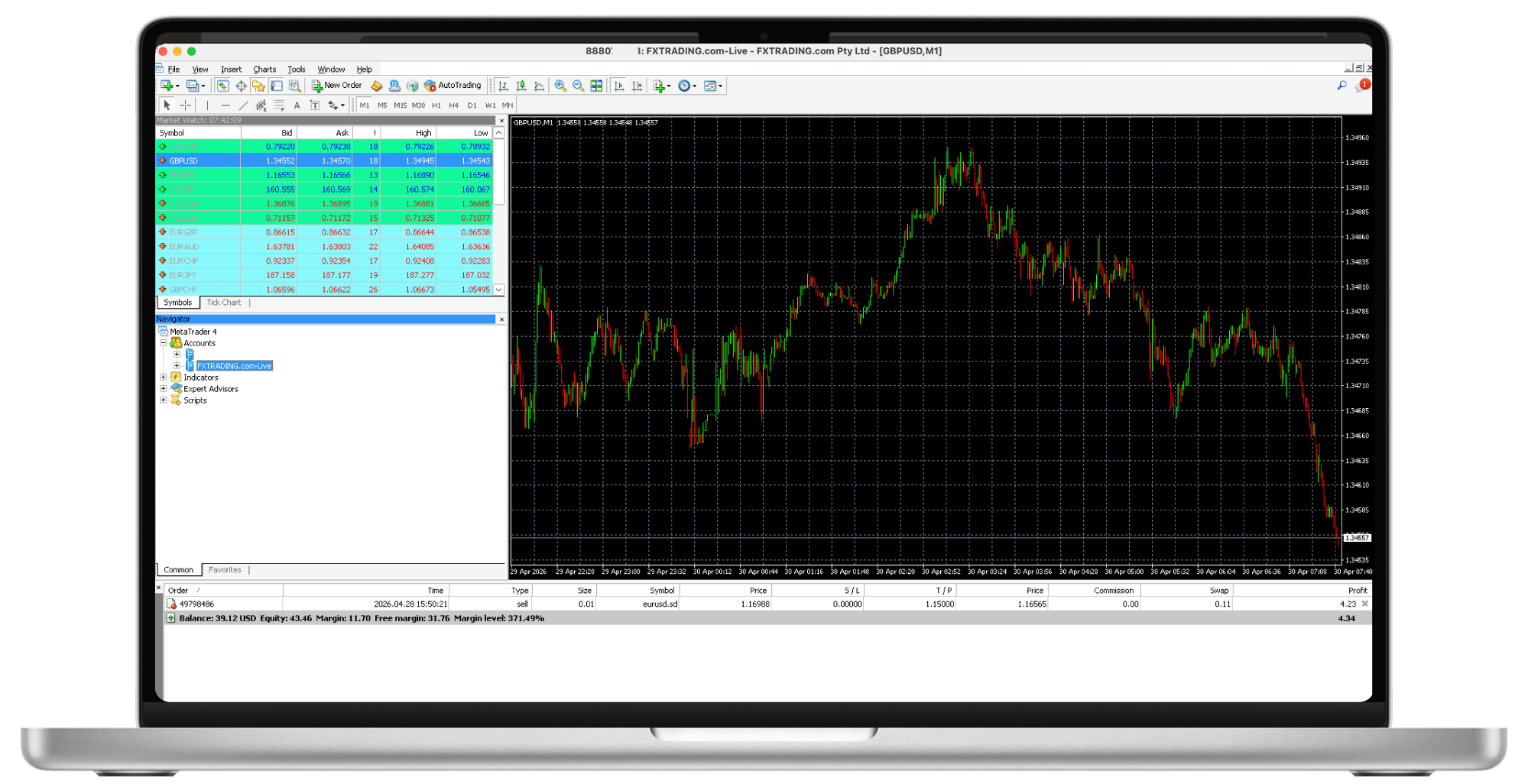
The trading platform is the software interface where you actually execute your trades. The popular options include MetaTrader 4 (MT4) or MetaTrader 5 (MT5).
These platforms connect you to the global market.
Your platform allows you to see live price quotes and manage your trades. It is your primary workstation where you monitor your account equity and view your trade history. You will spend most of your time here, so it is vital to familiarise yourself with the interface.
Broker
A broker acts as the intermediary between you and the interbank market. Individual traders cannot access the forex markets directly; you need us to provide the liquidity and the infrastructure.
Brokers also provide financial tools that can benefit traders. For example, the ability to trade on margin. This means you can control larger positions with a smaller amount of capital.
Brokers will also determine the currency pairs you have access to. For example, some brokers might not provide access to the SGD, for example. So if you want to trade the SGD, you’ll need to look for a broker that provides that option.
How to Place a Trade
First, you select the currency pair you wish to trade. You then decide whether you want to buy or sell based on your analysis.
After choosing your direction, you must enter the lot size. This determines how much of the currency you are controlling. There are three types of lots:
- Standard Lot: A Standard Lot represents 100,000 units of the base currency (the first currency listed in a pair). For example, if you are trading the EUR/USD, a standard lot is €100,000. A movement of one pip with a standard lot is worth approximately $10.
- Mini Lot: A Mini Lot is one-tenth the size of a standard lot, representing 10,000 units of the base currency. A one-pip movement here is worth roughly $1.
- Micro Lot: A Micro Lot is the smallest tradable size available, representing 1,000 units of the base currency. A one-pip movement is worth about $0.10.
If you’re placing a trade into a trading platform, the lots will be displayed as follows: “1” is a Standard Lot, “0.1” is a Mini Lot, and “0.01” is a Micro Lot.
Let’s say you’re trading the EUR/USD. If you’ve entered the EUR/USD with a 0.01 lot size, you’ve bought 1,000 units of the EUR.
You will also see options for Market Orders and Pending Orders.
A market order executes your trade immediately at the current price.
A pending order only executes if the price reaches a level you have designated.
Once you hit “Buy” or “Sell,” your trade is live and will appear in your Trade terminal. This is indicated by the fluctuating numbers.
Safety Strategies Beginners Should Observe
Trading involves risk, and your primary goal as a beginner should be preserving your capital. You must avoid the temptation to chase large gains without a safety net.
As such, observe the following tips if you’ve just started out:
Explore Paper Trading First
We highly recommend starting with a demo account, also known as paper trading. This allows you to trade in real market conditions using virtual funds.
For beginners, it lets you learn how to navigate the platform, as well as get a feel for real-world trading, without risking any of your actual money.
You can use paper trading to test your strategies and see how currency pairs move. It helps you understand how pips and lots translate into profit and loss.
While paper trading does not replicate the emotional pressure of using real money, it ensures you’re not scrambling across the interface when you eventually move to a live account. You should stay on a demo account until you are confident in your ability to execute trades with real money.
Set a Take-Profit and Stop-Loss
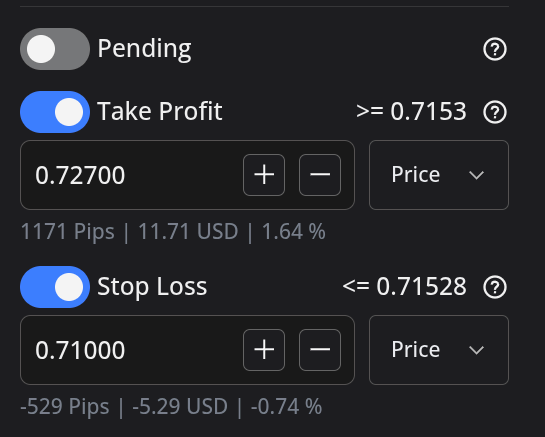
You should never enter a trade without an exit plan.
A stop-loss is an order that automatically closes your trade at a predetermined price if the market moves against you. Let’s say you’ve set your stop loss such that once you lose $5, the trade is closed. This means that you won’t lose more than $5 for that trade, even if the market moves $100 against your position. This prevents a small loss from turning into a catastrophic one.
A take-profit order works the opposite way. It automatically closes your trade and secures your profit when the price reaches your target. This is useful for those who can’t monitor their trades every hour, and may not necessarily be present when the price reaches an optimal and favourable position for them. Let’s say that you’ve set your TP at a level so that it closes once you gain $10. This means that when the price reaches that mark, you’ll gain $10, regardless if the market reverses into an unfavourable position.
Using both orders allows you to trade with discipline. You don’t have to sit in front of your computer screen every second, worrying about price fluctuations.
The 1% Rule
The 1% rule states that you should never risk more than 1% of your total account equity on a single trade. If you have a $10,000 account, you should not lose more than $100 on any given trade.
This rule protects you from a series of losses. If you risk 10% per trade, a string of five losses would wipe out half of your account.
If you follow the 1% rule, those same five losses only reduce your account by 5%. This conservative approach gives you the longevity needed to learn the markets.
In order to consistently implement the 1% rule, make sure to set your stop-loss to a level that stops your trade the moment it reaches 1% of your account.
Explore Leverage
Leverage allows you to control a large position with a small amount of money. For example, with 1:100 leverage, you can control $100,000 worth of currency with just $1,000 in your account.
While this can magnify your gains, it also magnifies your losses.
You must treat leverage with extreme caution. It is a tool that provides efficiency, and can allow traders to start with even a little budget—say, S$100.
But it can be dangerous if misused. As a beginner, you should avoid using the maximum leverage available to you. This ties back to our tip on paper trading. Try out different leverages and lot sizes. See which leverage results in a manageable mix of gains and losses for you.
Some of our traders found 1:20 to be an optimal leverage for them. But again, test this out on paper trading first.
Trading Strategies Beginners Can Follow
Following a Forex trading strategy helps you stay consistent and prevents you from making impulsive decisions based on a whim.
There will be a gargantuan number of strategies out there. However, here’s what we recommend for beginners:
Use the Moving Average Indicator
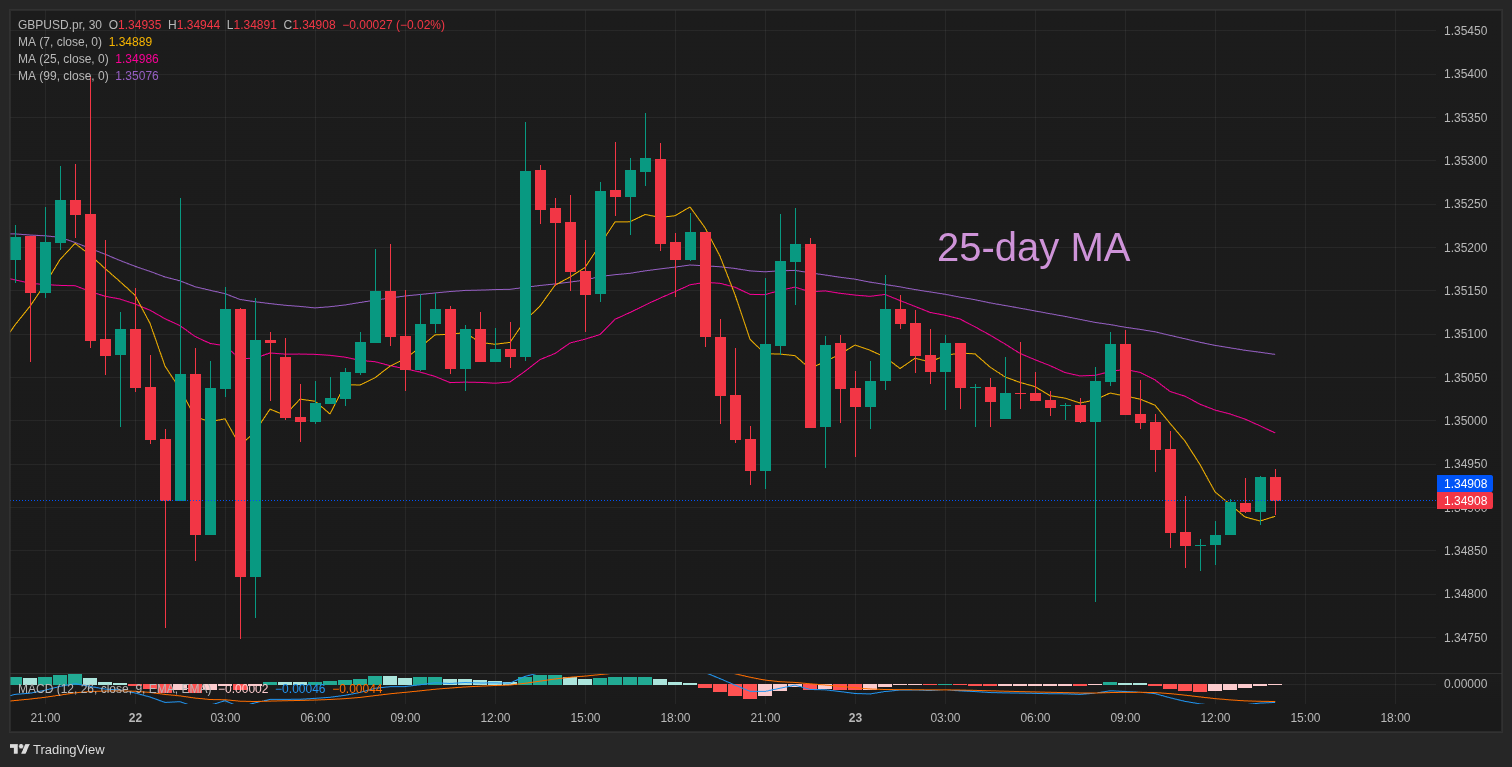
A moving average is a line on your chart that calculates the average price of a currency pair over a set number of periods. For example, a 50-period moving average shows the average price of the last 50 candles. It smooths out price data to help you see the direction of the trend.
If the price is consistently above the moving average, the trend is generally considered to be upward. If the price is below it, the trend is downward.
Beginners often use a crossover strategy. This involves using two moving averages—one fast (say, the 20-day MA) and one slow (say, the 50-day MA). When the fast line crosses above the slow line, it may signal a buying opportunity. If the fast line dips below the slow line, it may signal a shorting opportunity.
This is a simple visual way to identify momentum without needing complex calculations.
Follow Support and Resistance
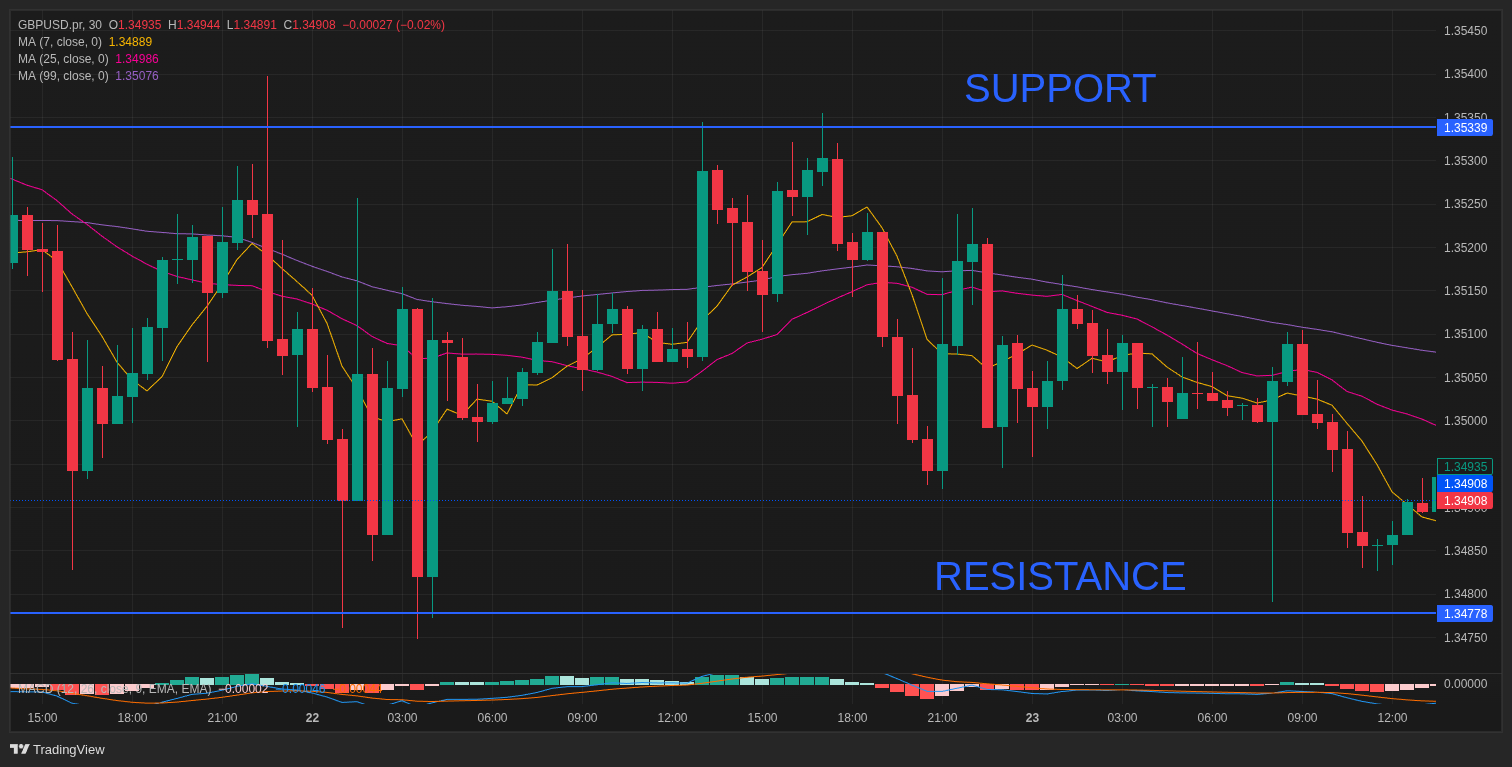
Support and resistance are levels where the price has historically struggled to pass.
Support is the floor where buying interest is strong enough to stop the price from falling further.
Resistance is the ceiling where selling pressure prevents the price from rising higher.
You can identify these levels by looking for areas where the price has bounced multiple times in the past. When the price approaches a support level, you might look for a reason to buy. When it hits resistance, you might look to sell. These levels are not exact lines but rather zones. Trading based on support and resistance is one of the most reliable ways to understand market psychology, as it shows you where other traders are likely to place their orders.
Buy The Dip
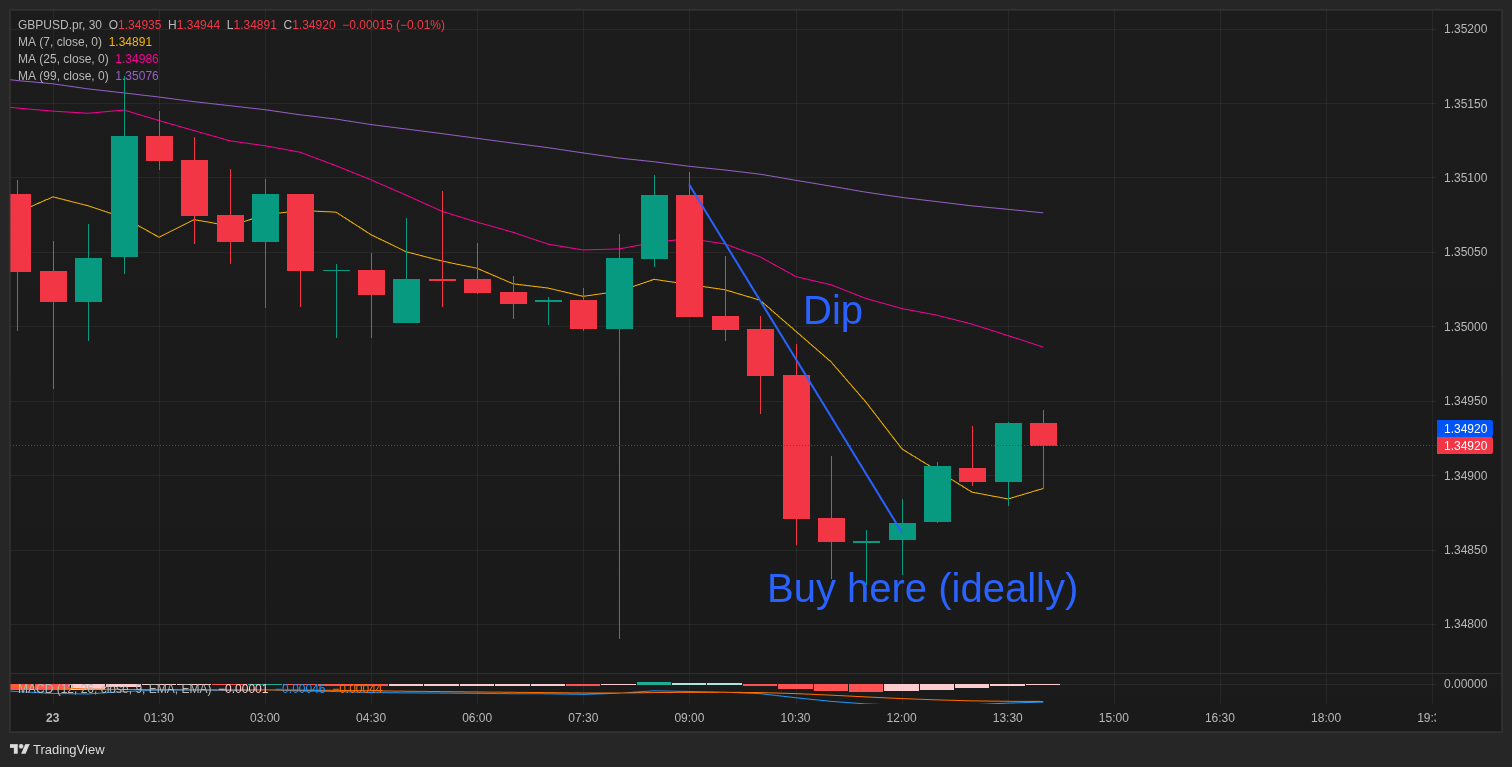
Buying the dip is a strategy used in trending markets. When a currency pair is in a strong uptrend, it rarely moves in a straight line.
It will often have small pullbacks or dips before continuing upward.
Your goal is to wait for these temporary price drops to enter the market at a better price.
Don’t Overwhelm Yourself with Different Strategies
One of the biggest mistakes you can make is trying to use too many indicators or strategies at once.
This leads to analysis paralysis, where you are too confused to make a move. Or worse, you might give yourself so much anxiety that your mental state makes you an incapable trader.
Focus on mastering one or two simple methods first. It is better to understand one strategy thoroughly than to have a surface-level knowledge of ten different ones.
Consistency is the key to progress in forex trading. Spend time observing how your chosen strategy performs in different market conditions. As you gain experience, you will naturally become better at reading the charts. Keep your charts tidy and focus on the most important information: price action.
How is Forex Trading Different from Trading Stocks?
While both involve buying and selling assets, forex and stocks have distinct differences.
The stock market is centralised and has set opening and closing hours. If you want to trade US stocks, you have to wait for the New York Stock Exchange to open. Forex, as we mentioned, is a decentralised 24-hour market.
Liquidity is another major factor. The forex market is far more liquid than the stock market. This means you can enter and exit huge positions almost instantly without causing the price to jump significantly. Additionally, forex trading typically offers higher leverage than stock trading. In the stock market, you are usually limited to 1:2 or 1:4 leverage, whereas in forex, you can access much higher ratios, with Singapore leverages going up to 1:50.
Finally, in forex, you are always trading a pair, which means you are always buying one thing and selling another, unlike stocks, where you are simply buying shares in a single company.
Trade More Than 70 Currency Pairs Today with FXT
You now have a foundation to start your journey.
At FXTRADING.com, we provide you with the tools and the environment to put this knowledge into practice. You can access over 80 currency pairs, including majors, minors and exotics.
We offer competitive spreads and reliable execution to ensure your trading experience is as smooth as possible. Our platforms are designed to be intuitive for beginners while offering the advanced features you will need as you grow.
Whether you want to trade the EUR/USD or explore more niche pairs, we are here to support your ambitions. Open an account with us today and take your first step into the global forex market.
Frequently Asked Questions
Is Forex trading legal in Singapore?
Yes, Forex trading is legal in Singapore and is regulated by the Monetary Authority of Singapore (MAS), which sets rules for leverage and conduct to protect retail investors.
What is the difference between a “Major” and an “Exotic” currency pair?
Major pairs include the US Dollar paired with other heavyweights (like EUR/USD), offering high liquidity and low spreads, while Exotic pairs involve a major currency and one from a developing economy (like USD/THB).
Do I need a high-end computer to start trading?
No, most modern trading platforms are optimised to run on standard laptops and even mobile devices, provided you have a stable internet connection for real-time price updates.
How much tax do I have to pay on Forex profits in Singapore?
In Singapore, capital gains from personal investments or trading are generally not taxable, though you should consult a professional if trading becomes your primary source of income.
Can I leave a trade open over the weekend?
You can, but it is risky because the market is closed; significant global events over the weekend can cause the price to jump significantly when the market reopens on Monday.
What is a “spread,” and how does it affect my profit?
The spread is the difference between the “Buy” and “Sell” price of a currency pair; it acts as a transaction cost that you pay to your broker for allowing you to trade with their tools and infrastructure.