USD/JPY Eyes 160: Can the Dollar Break Higher?


USD/JPY Maintains a Bullish Bias as Fed Tightening Expectations Provide Support
Market Summary
Rising US inflation has reinforced expectations that interest rates will remain elevated, providing continued support for the US dollar. Meanwhile, the likelihood of consecutive near-term rate hikes by the Bank of Japan (BoJ) has diminished, leaving the Japanese yen without a fresh monetary policy catalyst.
From a technical perspective, USD/JPY has gradually shifted higher, although key resistance levels remain intact. The pair is expected to maintain a mildly bullish consolidation pattern in the near term.
Fundamental Analysis
United States
US inflation accelerated again in September, further weakening expectations of a shift toward monetary easing. Headline Consumer Price Index (CPI) rose 0.6% month-on-month, its fastest increase in five months, while annual inflation climbed to 3.7%. Core CPI increased 0.3% month-on-month, with the annual rate rising from 2.4% to 2.6%, also exceeding market expectations. These figures suggest that inflationary pressures extend beyond energy prices.
Persistent inflation has strengthened the case for further monetary tightening by the Federal Reserve. Minutes from the September meeting indicated that most officials believed another interest rate hike could be necessary before year-end.
Markets currently assign approximately a 77% probability to rates remaining unchanged in October, while the likelihood of a hike of at least 25 basis points in December approaches 90%.
Meanwhile, the US 10-year Treasury yield has eased from around 5.36% to approximately 5.22%, but remains near multi-year highs. Elevated interest rates and bond yields continue to enhance the appeal of US dollar-denominated assets, providing strong near-term support for the currency.
Japan
Expectations of consecutive interest rate hikes by the Bank of Japan have moderated. Following September’s increase in the policy rate to 1.25%, policymakers appear inclined to assess the effects of monetary tightening on economic activity and inflation before taking further action.
Unless inflation risks intensify significantly, another rate hike in October appears unlikely. Overnight swaps indicate only around a 10% probability of a hike this month, compared with nearly 90% for December. Markets continue to anticipate that the policy rate could reach 1.50% around year-end.
Inflationary pressures have not fully subsided. Japan’s corporate goods prices rose 6.8% year-on-year in September, while import prices surged 24.5%. Costs for chemicals, non-ferrous metals, and other industrial materials remain elevated, alongside persistently high household inflation expectations.
However, corporate goods prices have declined month-on-month for two consecutive months, suggesting that some upstream cost pressures are beginning to ease.
With expectations for further tightening pushed back, the yen currently lacks a fresh policy-driven catalyst. Its next directional move may depend more heavily on the BoJ’s economic outlook in late October and signals from its December policy meeting.
Technical Analysis
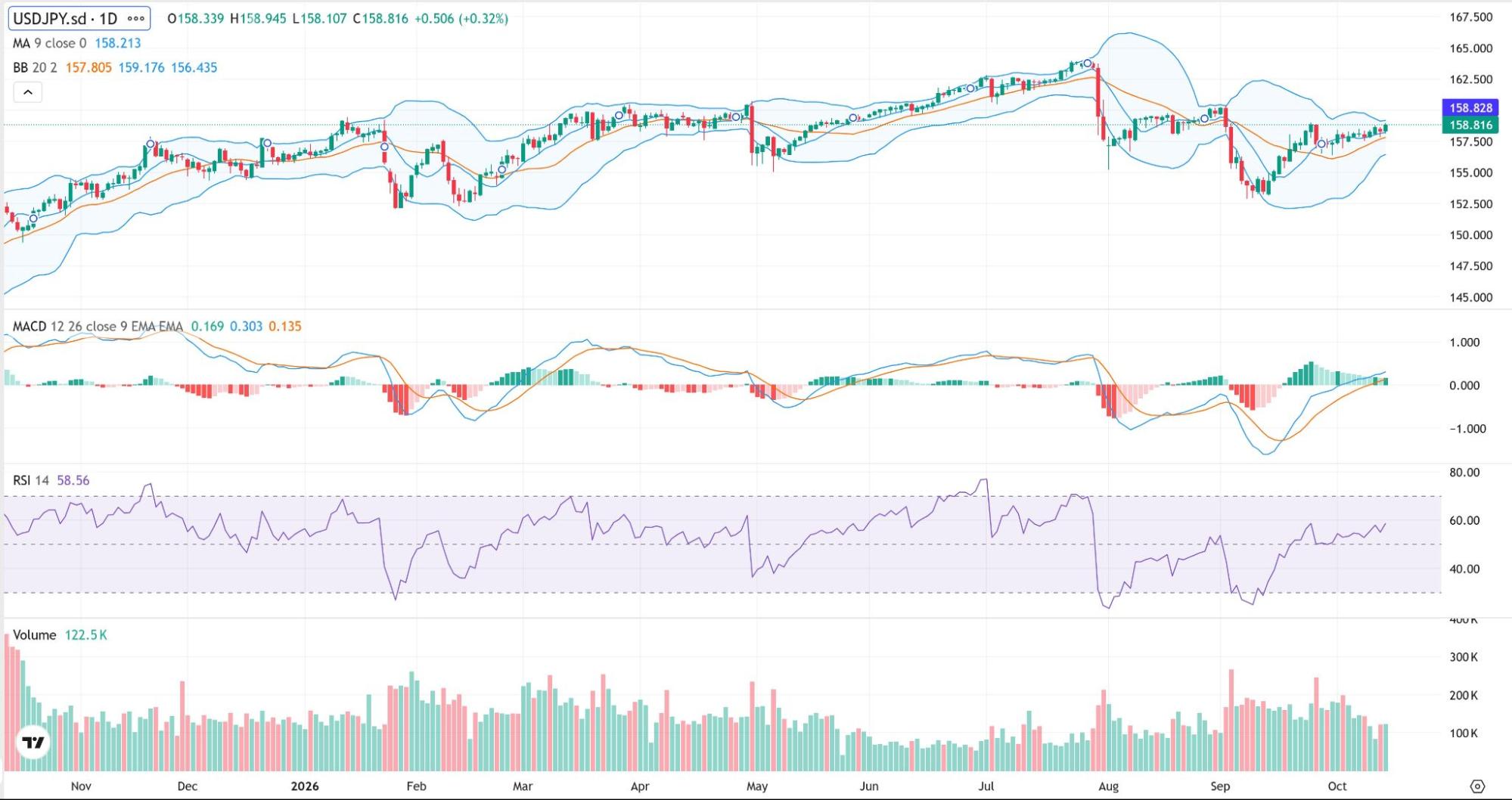
USD/JPY has recovered noticeably following September’s sharp decline and is currently trading near 158.80. The pair has moved back above its 9-day moving average, although upside momentum has yet to produce a decisive breakout.
Recent daily candlesticks have largely fluctuated between 157.50 and 159.00, with gradually rising lows suggesting a modest upward shift in short-term momentum. Nevertheless, selling pressure remains evident around 159.00.
A sustained breakout above 159.20 could extend the recovery toward 160.00 and potentially 161.00.
On the downside, initial support is located near 158.20. A break below this level could trigger another test of the 157.80–157.00 area. A further decline below 156.40 would significantly weaken the recent recovery structure.
Technical Indicators
The 9-day moving average currently stands near 158.21 and continues to trend gradually higher. With USD/JPY trading above this level, it provides a degree of near-term technical support.
Bollinger Bands show a middle band around 157.81, an upper band near 159.18, and a lower band around 156.44. The bands have narrowed noticeably, indicating declining volatility. With prices approaching the upper band, resistance above 159.00 deserves particular attention.
The MACD lines are converging upward, while the histogram has turned slightly positive. However, the indicator remains close to the zero line, suggesting that bullish momentum has yet to strengthen significantly.
The Relative Strength Index (RSI) has risen to 58.56, placing it in moderately bullish territory without indicating overbought conditions.
Overall, technical indicators suggest a gradual recovery, but a confirmed breakout is still required to establish stronger upside momentum.
Conclusion
USD/JPY’s fundamental outlook continues to favour the US dollar. Rising US inflation has maintained elevated expectations of another Federal Reserve rate hike before year-end, while the probability of consecutive BoJ tightening in October remains around 10%. This monetary policy divergence continues to limit the yen’s strength.
Technically, USD/JPY is holding above its 9-day moving average near 158.21, while the RSI has climbed to 58.56, reflecting an improvement in short-term momentum.
However, the 159.00–159.20 region remains a critical resistance zone. A confirmed breakout could open the way toward 160.00 and 161.00. Conversely, a decline below 158.20 could lead to renewed tests of 157.80–157.00, with 156.40 serving as an important level for assessing whether the recent recovery can continue.