US Midterms Shake Markets as Eurozone Inflation Surges


The US midterm elections have reshaped the balance of power in Congress, prompting investors to reassess the direction of fiscal policy over the next two years. As expectations for fiscal expansion weaken, declining US Treasury yields have placed downward pressure on the dollar.
Meanwhile, Eurozone inflation accelerated further in October, driven largely by rising energy prices. Persistent price pressures have reinforced expectations that the European Central Bank (ECB) will maintain a restrictive monetary policy stance.
Together, these two major developments are driving a reassessment of global currency markets, creating favourable conditions for a recovery in EUR/USD. Although technical indicators suggest improving bullish momentum, significant resistance levels remain in place, and a sustained breakout has yet to be confirmed.
Macroeconomic Overview
US Midterm Elections Shift Fiscal Expectations, Putting the Dollar Under Pressure
The US midterm elections have emerged as one of the most significant events influencing global financial markets this week.
With the Democratic Party gaining control of both the House of Representatives and the Senate, the political landscape in Washington has shifted. This change is expected to make it considerably more difficult for the Trump administration to advance tax cuts and expand government spending.
Investors have consequently begun reassessing the direction of US fiscal policy over the next two years, with growth expectations previously supported by large-scale stimulus measures beginning to moderate.
As expectations for fiscal expansion weaken, market assumptions regarding future Treasury issuance and economic growth have also shifted. US Treasury bonds have attracted increased buying interest, pushing yields lower and reducing the relative appeal of dollar-denominated assets.
Consequently, the US Dollar Index (DXY) has come under pressure.
Before the election, investors had accumulated substantial long positions in the dollar. The election outcome prompted some market participants to adjust their positions, amplifying short-term volatility across foreign exchange markets.
As the dollar weakened, other major currencies gained room to recover, with the euro emerging as one of the beneficiaries.
However, the shift in congressional control also introduces greater uncertainty surrounding future budget negotiations and policy implementation. Increased difficulty in advancing fiscal measures could affect corporate investment plans and broader market confidence.
Over the medium term, the dollar’s direction will continue to depend on US economic fundamentals and expectations surrounding Federal Reserve monetary policy.
Changes in employment, consumer spending, and inflation will remain central to how investors assess the future path of US interest rates.
Eurozone Inflation Accelerates, Increasing Pressure on ECB Policy
At the same time, the latest Eurozone inflation figures have become another major driver of market sentiment.
Eurozone headline Consumer Price Index (CPI) inflation rose 4.0% year-on-year in October, in line with market expectations, while monthly inflation increased by 0.4%.
The annual inflation rate is now twice the ECB’s 2% target, highlighting the persistence of price pressures across the region.
Energy prices remain the primary contributor to rising headline inflation, with annual energy inflation accelerating from 18.9% to 20.8%. The continued increase in energy costs is placing additional financial pressure on households and businesses.
In contrast, price pressures across other consumer categories have remained relatively moderate.
Core CPI held steady at 2.5%, while inflation excluding energy remained unchanged at 2.3%. Services inflation edged higher from 3.2% to 3.3%, while prices for food, alcohol, and tobacco increased by 1.6%. Non-energy industrial goods prices rose by 1.2%.
Inflation trends also varied significantly across Eurozone member states.
Italy’s inflation rate climbed to 5.6%, while France and Belgium recorded rates of 3.8% and 5.2%, respectively. Germany’s inflation eased to 2.8%, while Spain saw a modest decline to 4.9%.
The continued rise in energy costs presents an increasingly complex policy challenge for the ECB.
On one hand, headline inflation remains substantially above target, limiting the central bank’s flexibility to shift towards monetary easing.
On the other hand, higher energy costs could weaken corporate profitability and reduce households’ real purchasing power, potentially weighing on economic growth.
Against this backdrop, expectations that the ECB will maintain restrictive monetary conditions have strengthened, providing support for the euro.
With US fiscal expansion expectations weakening, the dollar under pressure, and persistent Eurozone inflation reinforcing the ECB’s restrictive policy stance, the divergence in US and European policy expectations is becoming an increasingly important driver of EUR/USD.
Technical Outlook
EUR/USD Recovery Gains Momentum as Key Resistance Levels Come Into Focus
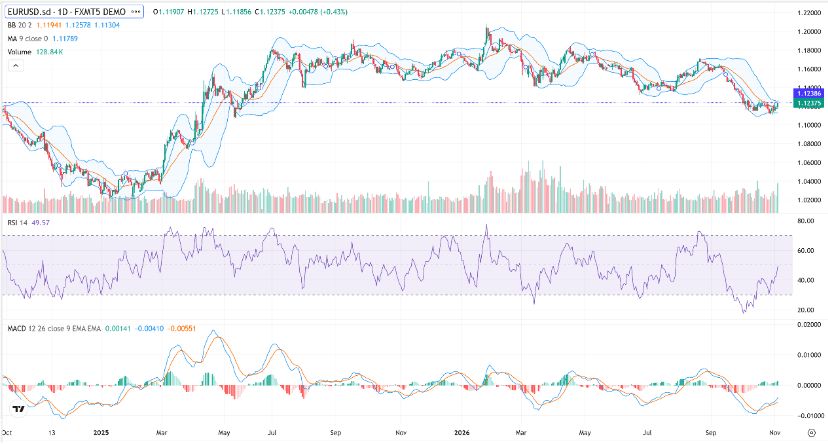
Against the backdrop of these macroeconomic developments, EUR/USD has gradually recovered from its recent downward trend.
On the daily chart, the pair found support near 1.1100 before beginning to move higher. It is currently trading around 1.12375, suggesting that short-term selling pressure has eased.
However, the broader price structure indicates that the pair remains in a recovery phase following its previous decline, rather than a confirmed bullish reversal.
EUR/USD has moved back above its short-term moving average and is approaching the upper Bollinger Band, indicating a gradual recovery in buying momentum.
Nevertheless, the pair has yet to break decisively above its previous descending structure, leaving the medium-term outlook subject to continued resistance.
The immediate upside level to monitor is the upper Bollinger Band near 1.12578, followed by the key psychological resistance area around 1.1300.
A sustained breakout above 1.1300 could open the door to further gains, with the next potential upside target located near 1.1400.
On the downside, initial support is positioned around 1.1194, followed by 1.1130.
If EUR/USD falls back below these levels, the pair could face renewed selling pressure and potentially retest the 1.1100 support area.
Technical Indicators Signal Improving Momentum, but Reversal Remains Unconfirmed
Technical indicators are beginning to reflect an improvement in EUR/USD’s short-term momentum.
The Bollinger Bands show a middle band at 1.11941, an upper band at 1.12578, and a lower band at 1.11304.
With EUR/USD trading above the middle band and approaching the upper boundary, the current price action suggests strengthening recovery momentum.
The 9-day moving average stands at 1.11789, and the pair has successfully moved back above this level, indicating an improvement in the short-term technical outlook.
The Relative Strength Index (RSI) has recovered to 49.57, gradually approaching the neutral 50 level.
This suggests that previous oversold pressure has eased considerably, although bullish momentum has not yet established a clear advantage.
Meanwhile, the Moving Average Convergence Divergence (MACD) indicator has formed a bullish crossover below the zero line, with the histogram turning positive.
This development indicates that bearish momentum is continuing to weaken while buying pressure gradually builds.
However, both MACD lines remain in negative territory, suggesting that the current signals are more consistent with a technical recovery than a fully established trend reversal.
Further confirmation would require EUR/USD to break above its key resistance levels and maintain upward momentum.
Conclusion: Political Shifts and Inflation Pressures Drive a New Phase of Currency Market Repricing
Overall, the US midterm elections and accelerating Eurozone inflation have emerged as two major events driving adjustments across global foreign exchange markets this week.
The changing balance of power in the US Congress has weakened expectations for fiscal expansion, contributing to lower Treasury yields and downward pressure on the dollar.
At the same time, Eurozone inflation remains well above the ECB’s target, reinforcing expectations that restrictive monetary policy will remain in place and providing support for the euro.
Together, these developments have helped improve the short-term outlook for EUR/USD.
However, the pair remains in a recovery phase following its previous decline, and a sustained trend reversal has yet to be confirmed.
From a technical perspective, a breakout above 1.12578, followed by a sustained move beyond 1.1300, could extend the recovery towards 1.1400.
Conversely, if bullish momentum fades and EUR/USD falls below 1.1194, the pair could retreat towards the 1.1130 and 1.1100 support areas.
Looking ahead, market attention is likely to shift from the immediate US midterm election results towards changes in fiscal policy under the new congressional balance of power, alongside the repricing of monetary policy expectations in the United States and Eurozone.
Upcoming US economic data, developments in Eurozone inflation, and EUR/USD’s ability to break through key technical resistance levels will collectively shape the next phase of currency market movements.
Related Posts