Eurozone Data Is Improving. So Why Is the Euro Still Under Pressure?


Eurozone economic activity continued to improve in September, yet the euro has struggled to translate that momentum into strength against the US dollar.
The Eurozone Composite PMI rose from 52.0 in August to 53.1 in September, reaching one of its strongest levels in nearly three years. Both manufacturing and services contributed to the improvement, suggesting that business activity remains resilient despite geopolitical uncertainty and elevated energy costs.
At the same time, EUR/USD has moved in the opposite direction. After failing to sustain its recent recovery near 1.16, the pair has come under renewed pressure, falling back towards levels last seen around July.
This apparent contradiction highlights an important feature of currency markets: stronger economic data does not automatically translate into a stronger currency. For EUR/USD, the more important question may be how the Eurozone outlook compares with that of the United States—and whether those differences change expectations for the European Central Bank (ECB) and the Federal Reserve (Fed).
Stronger Eurozone Data Hasn’t Been Enough
The latest PMI figures provide encouraging signs for the Eurozone economy. Improving activity across both manufacturing and services suggests that demand has remained relatively resilient despite an uncertain external environment.
However, currency markets are inherently relative.
For the euro, stronger European data matters not only because of what it says about the regional economy, but because of how it changes expectations relative to the US.
The US economy has also remained resilient, while recent inflation and activity data have led markets to reassess the potential path of Federal Reserve policy. If US economic conditions remain firm enough for restrictive monetary policy to persist, improving Eurozone growth alone may not be sufficient to generate sustained upside in EUR/USD.
The key question therefore becomes less about whether Europe is recovering and more about whether that recovery is strong enough to materially alter the expected ECB–Fed policy gap.
Energy Could Reshape the ECB–Fed Policy Gap
Energy prices add another important dimension to this comparison.
Europe remains relatively dependent on imported oil and natural gas. Changes in global energy prices can therefore feed directly into household costs, industrial production expenses and broader inflation conditions.
If geopolitical tensions keep energy prices elevated, inflationary pressure could remain persistent and complicate the ECB’s policy outlook. Conversely, if tensions ease and oil prices decline, lower imported energy costs could reduce inflation pressure and influence expectations around how restrictive ECB policy needs to remain.
The effect could be different in the United States.
The US has greater domestic oil and gas production capacity and is therefore less dependent on imported energy than the Eurozone. US inflation is also driven by a broader range of domestic factors, including housing costs, services inflation, wage growth and consumer demand. This means falling oil prices may reduce some inflationary pressure without necessarily producing the same change in the broader US inflation outlook.
This creates the possibility of an asymmetric policy response.
If lower energy prices ease European inflation more quickly while US domestic inflation remains relatively persistent, expectations for the ECB and Fed could move at different speeds. That relative shift—not simply the direction of European economic growth—could become increasingly important for EUR/USD.
Geopolitical developments may therefore remain relevant. If improving US-Iran relations were to reduce the risk premium embedded in energy prices, Europe could potentially experience a more noticeable easing in inflation pressure. However, whether this ultimately produces a meaningful divergence between ECB and Fed expectations will depend on incoming economic data and how policymakers respond.
EUR/USD Technical Picture Remains Under Pressure
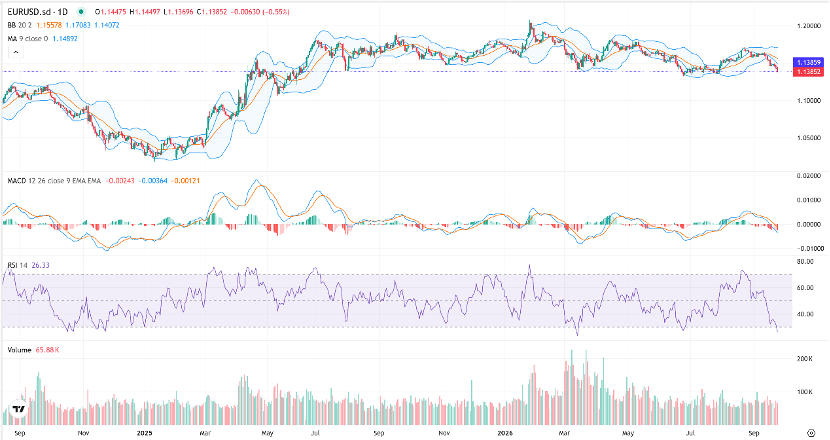
The technical picture has weakened alongside these macro developments.
EUR/USD recently attempted to recover towards the 1.16 area, but the move failed to hold. The pair subsequently declined for several consecutive sessions, with the latest close around 1.13852.
Price has now fallen below the 9-day moving average and moved towards the lower Bollinger Band, disrupting much of the recovery structure that had developed since August. EUR/USD has also returned towards the price region around its July lows, placing greater attention on nearby support levels.
The 9-day moving average currently sits near 1.14892, while the Bollinger Band midline is around 1.15578 and the lower band near 1.14072. With price trading below these short-term reference points, the immediate structure remains weak.
Momentum indicators reinforce that picture. MACD has moved below the zero line and the negative histogram has expanded, suggesting that downside momentum remains active.
However, RSI introduces an important counter-signal.
The indicator has fallen to approximately 26.33, placing EUR/USD in oversold territory. An oversold reading does not necessarily indicate that a reversal is imminent, particularly when downside momentum remains strong. It does, however, suggest that the recent decline has become increasingly stretched and that the possibility of a short-term technical correction should also be considered.
The technical picture is therefore somewhat two-sided: the broader short-term structure remains under pressure, but increasingly oversold conditions may raise the potential for a corrective rebound.
Key Levels and Possible Scenarios
On the downside, 1.1323 remains an important initial support area. A sustained break below this level could reinforce the current weak structure and shift attention towards the psychological 1.1300 region.
On the upside, the first important resistance area sits around 1.1490, close to the 9-day moving average.
If oversold conditions lead to a technical recovery, this area could provide an early indication of whether the rebound is simply a short-term correction or whether immediate selling pressure is beginning to ease.
The broader 1.16 region also remains significant following the recent failed recovery. A return towards this area would require a more substantial change in the current technical structure.
Rather than pointing towards a single outcome, the current setup leaves several possibilities open. Continued US economic resilience and a persistent ECB–Fed policy gap could keep EUR/USD under pressure, while softer dollar conditions or changing policy expectations could allow oversold technical conditions to develop into a recovery. If neither side receives a strong new catalyst, consolidation between key support and resistance levels may also become increasingly likely.
Outlook: Relative Policy Expectations Remain the Key
The central question for EUR/USD is no longer simply whether the Eurozone economy is improving. Recent PMI data suggest that it is.
The more important issue is whether that improvement is strong enough to change the relative monetary-policy outlook between Europe and the United States.
Energy prices could play an important role in that equation because of Europe’s greater sensitivity to imported energy costs. At the same time, US inflation remains influenced by persistent domestic factors, potentially creating different policy implications from the same movement in global energy prices.
For now, EUR/USD remains technically under pressure, although oversold conditions suggest that short-term volatility could move in both directions.
Market attention is therefore likely to remain focused on energy prices, incoming Eurozone and US economic data, evolving ECB and Fed expectations, and the behaviour of EUR/USD around 1.1323 support and 1.1490 resistance.
Disclaimer: This material is provided for general information and market analysis purposes only and does not constitute investment or trading advice.
Related Posts