USD/CAD Under Pressure: Oil Strength Meets a Resilient US Dollar


USD/CAD remains under pressure as two competing macro forces continue to shape the pair: resilience in the US economy is providing support for the US dollar and Treasury yields, while elevated oil prices are offering a tailwind to the Canadian dollar.
From a technical perspective, USD/CAD continues to trade below key moving-average and Bollinger Band levels. However, RSI and MACD indicators suggest that downside momentum may be starting to ease.
Key Takeaways
- USD/CAD remains in a broadly weaker technical structure following its decline from the July highs.
- Resilient US employment data continues to provide some support for the US dollar and Treasury yields.
- Higher oil prices are supporting the Canadian dollar through Canada’s position as a major energy exporter.
- 3730 remains an important support level for USD/CAD.
- 3840–1.3900 is the key resistance zone to watch for signs of a potential improvement in the pair’s current structure.
US Dollar: Employment Resilience Provides Support, but Momentum Remains Limited
US employment data remained resilient in August, with nonfarm payrolls increasing by 162,000 and the unemployment rate holding at 4.1%.
The stronger labour-market picture reinforced expectations that US interest rates could remain elevated. As concerns around employment eased, markets increased expectations for further Federal Reserve tightening, with the implied probability rising to around 60% at one stage.
This provided some fundamental support for both US Treasury yields and the dollar.
However, the dollar’s actual performance has remained relatively restrained. The US Dollar Index fell to around 98.8 on 8 September, highlighting continued uncertainty around the US interest-rate outlook.
While the improvement in employment data has reduced expectations for near-term monetary easing, it has not yet been sufficient to reverse the dollar’s broader soft tone.
Looking ahead, the direction of the dollar may depend increasingly on inflation developments and how the Federal Reserve balances resilient employment conditions against ongoing price pressures. For now, employment data alone appears to have had a relatively limited impact on the broader currency trend.
Canadian Dollar: Oil Prices Remain an Important Tailwind
On the Canadian side, strength in crude oil prices continues to provide support for the Canadian dollar.
Uncertainty surrounding transportation through the Strait of Hormuz remains a factor in global energy supply expectations. Concerns over potential constraints on crude exports have helped keep the risk premium in oil prices elevated.
As a major energy exporter, Canada can potentially benefit from higher oil prices through improved terms of trade, stronger export revenues and associated capital flows—all of which may provide support for the Canadian dollar.
Domestically, the Bank of Canada has maintained its policy rate at 2.25%, while continuing to monitor the potential transmission of higher energy costs into inflation.
Canadian inflation has risen to around 3%, while annualised economic growth reached 3.3% in the second quarter, suggesting that parts of the economy remain resilient.
The labour market, however, has shown some signs of weakness. Employment declined by 41,700 in August, while the unemployment rate remained at 6.4%.
This combination of economic growth and softer employment conditions could complicate the Bank of Canada’s policy outlook. In the near term, movements in oil prices may therefore remain an important external factor influencing the Canadian dollar.
Technical Outlook: Downside Momentum Is Easing, but a Reversal Is Not Yet Confirmed
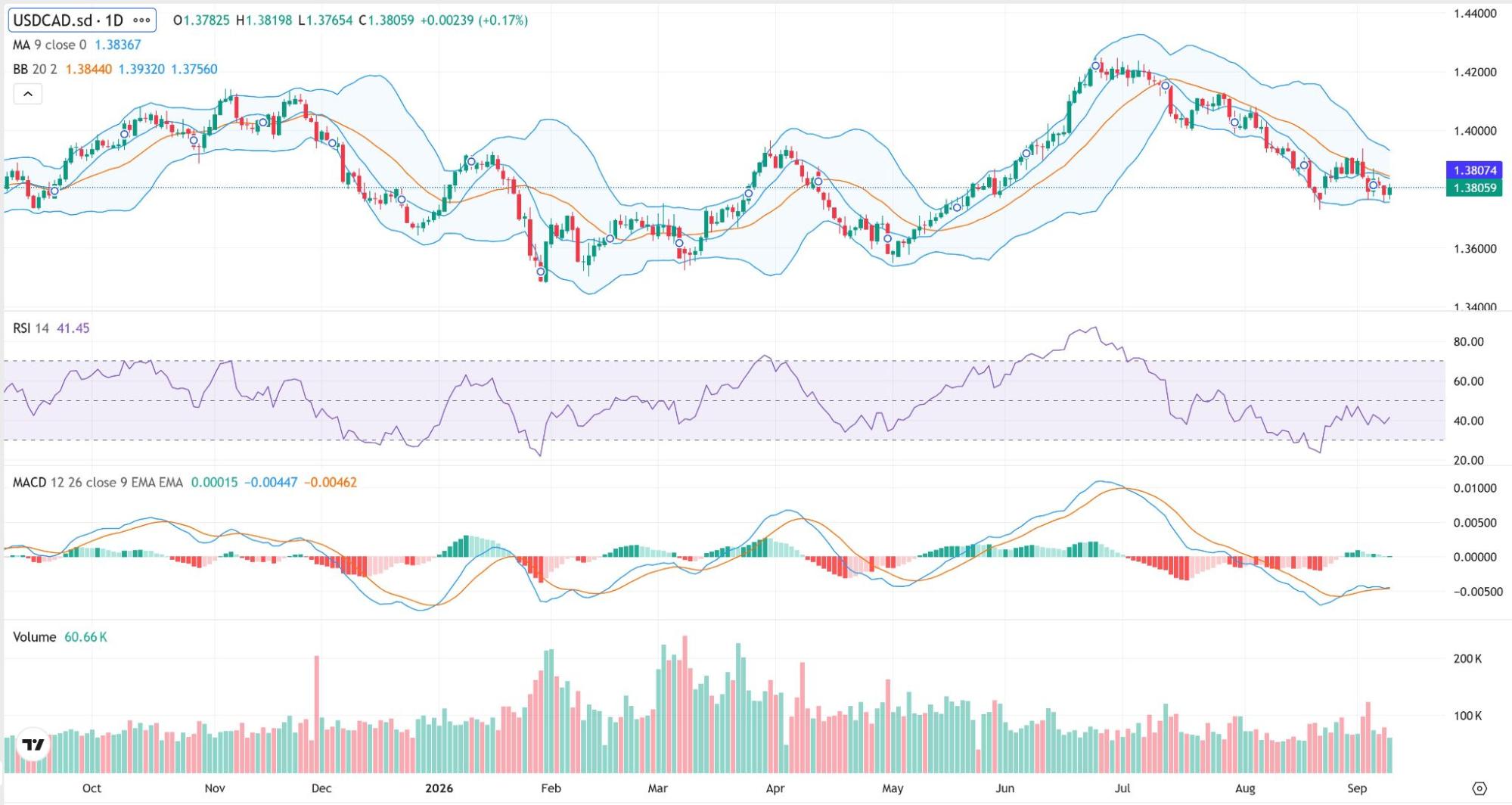
On the daily chart, USD/CAD has maintained a broadly downward trajectory since retreating from its July highs.
The pair recently found support around 1.3730 and staged a modest rebound. However, at approximately 1.3806, USD/CAD remains below both the 9-day moving average at 1.3837 and the Bollinger Band midpoint around 1.3844.
This keeps the broader corrective structure intact.
On the upside, the first area to watch is 1.3840–1.3900. A sustained move back above this zone could potentially create room for a broader recovery.
On the downside, 1.3730 remains an important support level. A sustained break below this area could bring 1.3700 and previous lows back into focus.
What Are the Indicators Showing?
The Bollinger Band midpoint is currently around 1.3844, while the lower band has moved down towards 1.3756. With USD/CAD trading between the midpoint and lower band, downside pressure remains present, although the pace of the decline has slowed as price approaches the lower part of the range.
The RSI is around 41.45, remaining below the neutral 50 level but recovering from levels closer to oversold territory. This suggests that selling pressure has eased compared with earlier stages of the decline.
Meanwhile, the MACD remains below the zero line, although the two lines have begun converging at lower levels and the histogram has narrowed noticeably.
Together, these indicators suggest that bearish momentum may be weakening. However, they do not yet provide a clear confirmation of a trend reversal.
The 1.3840 area therefore remains an important level to monitor for further evidence of a potential shift in momentum.
What to Watch Next
USD/CAD remains caught between two competing forces: support for the US dollar from resilient economic conditions and interest-rate expectations, and support for the Canadian dollar from elevated oil prices.
From a technical perspective, the pair continues to trade with a weaker bias, although momentum indicators suggest that selling pressure may be moderating.
Two areas remain particularly important:
Support: 1.3730
A sustained move below this level could potentially reopen downside towards 1.3700 and previous lows.
Resistance: 1.3840–1.3900
A sustained recovery above this zone could improve the pair’s current technical structure and bring a broader rebound into consideration.
Until either area is decisively broken, USD/CAD may remain within a relatively weak consolidation phase as traders assess the balance between US rate expectations and oil-driven support for the Canadian dollar.
This market analysis is for general information only and does not constitute investment advice. Trading involves significant risk.
Related Posts