USD/JPY Under Pressure as BOJ Rate Hike Expectations Build


US labour market momentum is cooling just as expectations for further Bank of Japan tightening are gaining traction. With monetary policy expectations between the two economies beginning to diverge, USD/JPY has retreated from its July highs and is now trading around the 159 level. Technical indicators also point to a slight near-term bearish bias, putting 158.00 firmly in focus as the next key support.
US Labour Market Shows Further Signs of Cooling
US private-sector hiring continued to lose momentum in August, adding just 38,000 jobs, below market expectations of 48,000 and July’s upwardly revised 46,000 increase. This marked the weakest reading since January.
The underlying picture was mixed. Manufacturing employment declined by 17,000, while professional and business services shed 16,000 jobs. Employment in the information sector also contracted. In contrast, education and healthcare, construction, and leisure and hospitality continued to add workers.
Hiring also remained uneven across company sizes, with most of the new jobs coming from larger businesses while small and medium-sized firms continued to show limited appetite for recruitment.
Wage growth is cooling alongside hiring. Overall base pay increased 3.2% year-on-year, while pay growth for employees who remained in their roles slowed to 3.0%. Job switchers recorded stronger wage growth of 4.7%, but this too reflects a broader moderation in labour market momentum.
Recent ADP readings have consistently remained subdued, suggesting that US companies are becoming increasingly cautious about expanding their workforces.
Demographic changes and persistent cost pressures may be contributing to this shift. The growing role of artificial intelligence in replacing or reshaping certain jobs could also be adding another layer of uncertainty to hiring decisions.
For markets, the broader message is becoming increasingly difficult to ignore: US labour demand is losing momentum, potentially weakening one of the pillars that has supported expectations for relatively high US interest rates.
BOJ Tightening Expectations Move in the Opposite Direction
While US employment conditions are cooling, markets are reassessing how quickly the Bank of Japan may continue normalising monetary policy.
BOJ board member Hajime Takata recently delivered a more hawkish signal, suggesting that future policy adjustments do not necessarily need to follow predetermined increments or fixed intervals.
Importantly, Takata indicated that individual rate increases may not necessarily be limited to 25 basis points, while consecutive increases could also remain an option.
Governor Kazuo Ueda subsequently said that the September policy meeting would closely assess developments in economic activity, prices and inflation risks, putting greater attention on whether the BOJ could accelerate its normalisation process.
The backdrop is becoming increasingly important.
A relatively weak yen, combined with higher energy costs, risks pushing import prices higher and eventually feeding through to domestic inflation. If these pressures persist, the BOJ may have less room to maintain deeply negative real interest rates.
Japan’s bond market is already responding to this shift in expectations. The 10-year Japanese government bond yield has climbed to 3.00%, its highest level since 1996, while short- and medium-term yields are also trading around multi-year highs.
Taken together, the moves suggest investors are already adjusting their expectations for Japan’s future interest-rate path.
For USD/JPY, this creates an increasingly important divergence: US rate support is showing signs of weakening just as expectations for Japanese tightening are strengthening.
USD/JPY Technical Outlook: 158.00 Becomes the Key Level
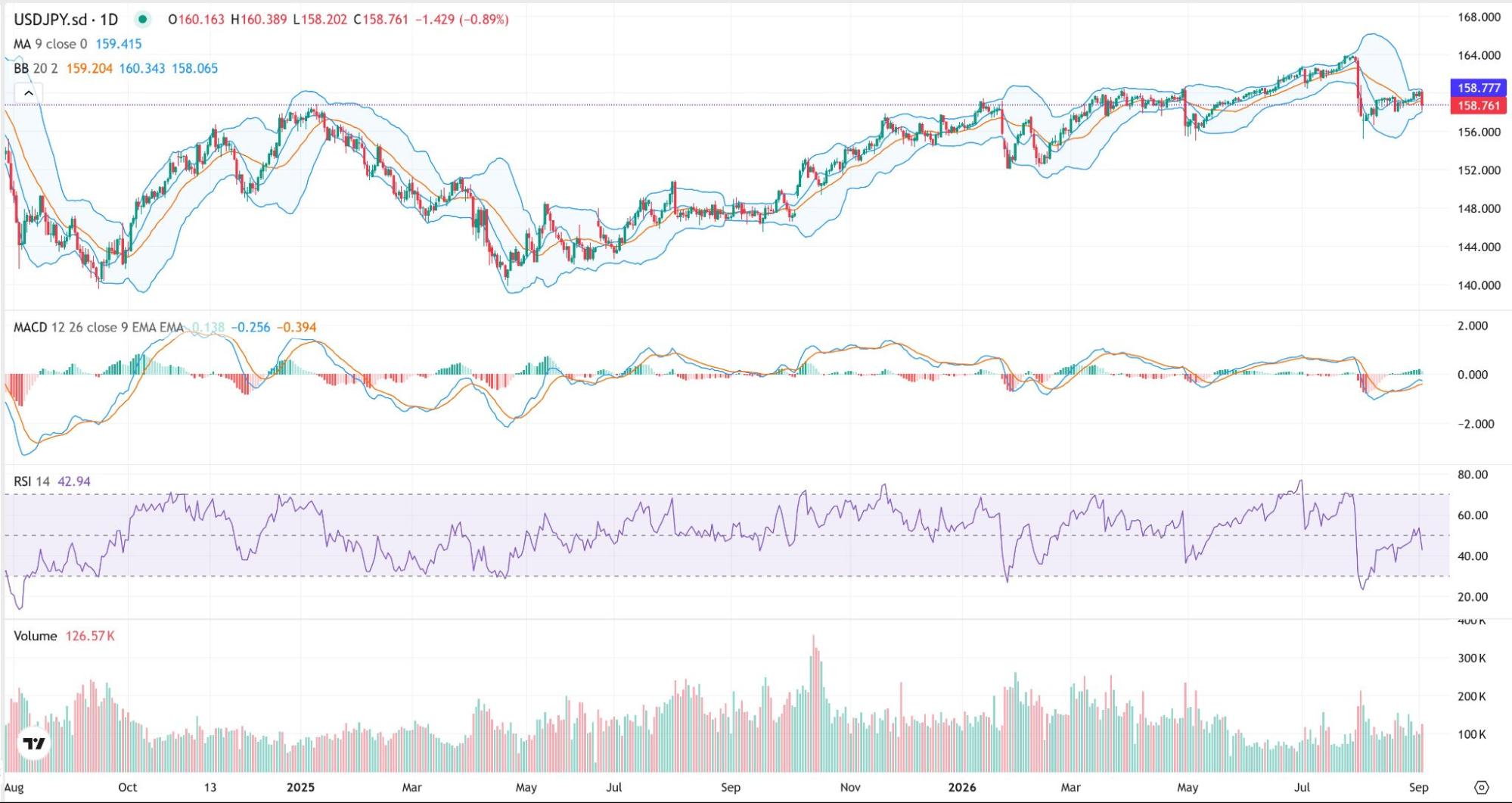
From a daily-chart perspective, USD/JPY’s previous one-way advance has already lost momentum.
After climbing to around 164 in July, the pair experienced a sharp pullback before entering a broader consolidation range between approximately 157 and 160.
USD/JPY has most recently fallen back towards 158.76, moving below its 9-day moving average at approximately 159.42 and indicating an increase in short-term selling pressure.
The immediate technical picture can be framed around several important levels:
- 40–160.35: Key resistance zone
- Above 160.40: A sustained break could reopen the path towards 161.00 and potentially the previous highs
- 00: Key near-term support
- Below 158.00: A daily break could expose the 157.00–156.00 area
For now, the broader structure therefore points towards weak consolidation near the highs rather than a confirmed new downtrend.
Momentum Indicators Lean Bearish — But Not Decisively
The Bollinger Band midline currently sits around 159.20, with USD/JPY moving back below it and gradually approaching the lower band near 158.07.
This suggests that the short-term price centre of gravity is shifting lower, although the pair has yet to establish a decisive technical breakdown.
The MACD presents a more nuanced picture. While it remains below the zero line, the faster line has previously crossed above the slower line and the histogram remains slightly positive. This suggests that the momentum behind the earlier decline has eased, even though the subsequent recovery has lacked strength.
The RSI has meanwhile fallen back to approximately 42.9, moving below the neutral 50 level and into weaker territory. However, it remains comfortably above the 30 threshold typically associated with oversold conditions.
Taken together, the moving averages, Bollinger Bands and momentum indicators currently give sellers a slight advantage — but they do not yet point to a decisive bearish breakout.
That makes the market’s reaction around 158.00 particularly important.
What Comes Next for USD/JPY?
The fundamental backdrop currently favours a softer bias for USD/JPY.
Cooling US employment conditions are weakening support from the US rates side, while the possibility of a faster BOJ tightening cycle is providing greater support for the yen. At the same time, the technical picture has deteriorated, with USD/JPY falling below its short-term moving average and Bollinger Band midline while RSI moves back into weaker territory.
However, MACD suggests that downside momentum has not yet accelerated meaningfully.
The current environment therefore looks more like bearish consolidation than the beginning of a confirmed one-way decline.
The next major test is 158.00.
A sustained daily break below this level could expand the correction towards 157.00–156.00. On the other hand, a recovery above 160.40 would be needed to materially weaken the current bearish structure and bring higher levels back into focus.
For traders, the next phase may therefore depend less on whether USD/JPY simply moves lower and more on how price reacts around 158.00 — and whether expectations for further BOJ tightening continue to build.
This material is provided for general information purposes only and does not constitute financial advice. Past performance is not indicative of future results.
Related Posts