USD/CAD Rally Fades. What’s Next?


The US economy continues to demonstrate resilience, reinforcing expectations of further monetary tightening by the Federal Reserve and providing fundamental support for the US dollar.
Meanwhile, although Canadian retail sales have increased, underlying consumer demand remains relatively weak when the effects of rising energy prices and automotive sales are excluded.
Following a sustained rebound, USD/CAD has encountered technical resistance, with short-term bullish momentum beginning to fade. The pair’s next move will largely depend on whether key technical support levels hold and whether buyers can regain momentum.
Macroeconomic Overview
US Economic Resilience Strengthens Fed Rate Hike Expectations
The US dollar continues to receive support from stronger-than-expected economic data and growing expectations of further interest rate hikes by the Federal Reserve.
TD Securities has revised its monetary policy forecast, now anticipating three consecutive Fed rate hikes beginning in December. The revision reflects concerns that inflationary pressures have yet to be effectively contained, alongside signs of stabilisation in the labour market and continued resilience in economic activity.
US third-quarter real GDP growth was revised upwards from an annualised rate of 3.4% to 4.3%, significantly exceeding market expectations.
Both investment and consumer spending showed improvements, with investment in intellectual property products, particularly software, emerging as an important driver of economic growth. Consumer spending on pharmaceutical products, recreational goods and energy products was also revised higher.
Real final sales to private domestic purchasers, a key measure of underlying private-sector demand, were revised upwards to 5.8%. Meanwhile, real gross domestic income (GDI) increased by 4.4%, further highlighting the resilience of the US economy.
However, real consumer spending stagnated in October, raising questions about whether the strong economic performance recorded in the third quarter can be sustained.
While the latest economic figures continue to support expectations of tighter monetary policy, upcoming consumption and inflation data will remain important in determining the Fed’s future policy direction.
Canadian Retail Sales Rise, but Underlying Consumer Demand Remains Weak
In Canada, retail sales increased by 0.8% month-on-month in September, reaching CAD 75.3 billion and slightly exceeding market expectations.
However, underlying consumer spending was less robust than the headline figures suggest.
Excluding motor vehicle and parts dealers, retail sales increased by 1.0%. When both automotive and fuel sales were excluded, core retail sales rose by just 0.1%. Retail sales adjusted for inflation also increased by only 0.1%.
Across individual sectors, sales at gasoline stations and fuel vendors surged by 6.9%, primarily driven by higher fuel prices, while actual sales volumes increased by just 1.6%.
Five of the nine major retail subsectors recorded growth, with department stores and clothing retailers performing relatively well. In contrast, sales of food and beverages, building materials and furniture declined.
The latest figures suggest that nominal retail sales growth was significantly influenced by rising energy prices rather than a broad-based recovery in consumer demand.
Underlying household consumption remains relatively subdued, limiting its ability to provide sustained support for Canadian economic growth.
The divergence between resilient US economic activity and relatively weak Canadian consumer demand continues to provide fundamental support for USD/CAD over the medium term.
Technical Outlook
USD/CAD Pulls Back as Bullish Momentum Weakens
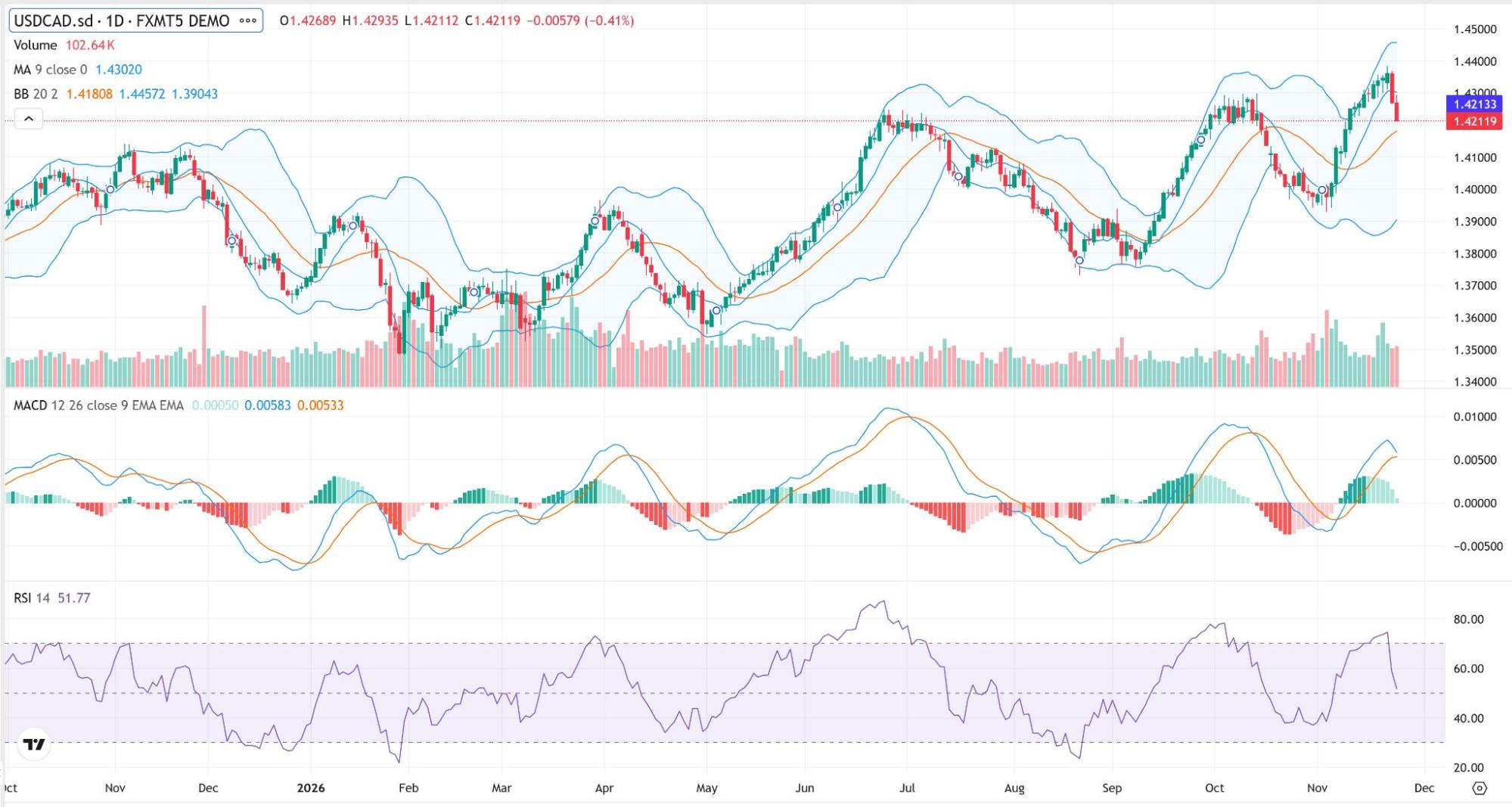
From a daily chart perspective, USD/CAD has entered a corrective phase following a sustained rebound.
The pair previously rallied sharply from its November lows, briefly approaching the area above 1.4400. However, resistance near the upper Bollinger Band triggered increased short-term selling pressure.
USD/CAD has since fallen below its 9-day moving average at 1.4302, indicating that near-term bullish momentum has weakened.
Nevertheless, the pair remains above the middle Bollinger Band at 1.4181, suggesting that the broader recovery structure remains intact for now.
On the downside, the area around 1.4180 represents a key support zone. If USD/CAD breaks decisively below this level, the correction could extend towards the psychological level of 1.4000.
On the upside, a recovery above 1.4300 could ease short-term selling pressure and potentially allow the pair to retest the resistance zone between 1.4400 and 1.4457.
Technical Indicators Signal Fading Bullish Momentum
The Bollinger Bands continue to reflect relatively active market volatility, with the middle band positioned at 1.4181, the upper band at 1.4457 and the lower band at 1.