USD/JPY Breaks Higher. Can the Rally Last?


US inflation has cooled less than expected, reinforcing the Federal Reserve’s hawkish stance and providing support for the US dollar. However, easing geopolitical tensions in the Middle East have reduced safe-haven demand, potentially limiting further dollar gains.
Meanwhile, expectations of another Bank of Japan (BoJ) rate hike are strengthening as policymakers increasingly discuss accelerating monetary policy normalisation. Diverging policy expectations between the two central banks continue to shape the outlook for the Japanese yen.
Against this backdrop, USD/JPY has moved back above a key resistance area, with short-term bullish momentum gaining traction. Nevertheless, traders remain focused on overhead resistance levels and whether the current upward momentum can be sustained.
Macroeconomic Overview
US Inflation Remains Sticky, Reinforcing the Fed’s Hawkish Outlook
The latest US inflation figures suggest that price pressures are easing more slowly than markets had anticipated, reinforcing expectations that the Federal Reserve may need to maintain restrictive monetary conditions for longer.
The US Consumer Price Index (CPI) rose 0.4% month-on-month in October, exceeding market expectations of 0.3%, although moderating from September’s 0.6% increase.
Core CPI, which excludes volatile food and energy prices, increased by 0.3%, unchanged from the previous month and above the 0.2% forecast.
Due to the impact of last year’s government shutdown, the Bureau of Labor Statistics did not publish year-on-year inflation figures for October.
Although headline inflation showed signs of moderation, persistent underlying price pressures have kept investors cautious about the timing and extent of any potential shift in Federal Reserve policy.
Chicago Federal Reserve President Austan Goolsbee also delivered hawkish signals, expressing concern over the latest inflation readings and highlighting the lack of meaningful cooling in service-sector prices.
His remarks suggested that persistent inflation could eventually require further policy action from the central bank.
A sentiment-tracking measure assigned his comments a hawkishness score of 8, compared with a historical average of 6.8, indicating a more restrictive tone than usual.
If upcoming economic data fail to demonstrate a sustained decline in inflation, the Federal Reserve may have limited room to lower interest rates, potentially keeping monetary policy restrictive for an extended period.
Such expectations could continue to support the US dollar, particularly against currencies whose central banks maintain relatively accommodative policy settings.
However, geopolitical developments may limit the dollar’s upside.
Growing hopes for a diplomatic resolution between the United States and Iran have contributed to expectations of easing tensions in the Middle East.
Both President Donald Trump and Secretary of State Marco Rubio have suggested that the conflict could move towards de-escalation.
A reduction in geopolitical uncertainty could weaken safe-haven demand for the US dollar, potentially offsetting some of the support generated by the Federal Reserve’s hawkish policy outlook.
Bank of Japan Signals Greater Urgency as December Rate Hike Expectations Build
In Japan, monetary policy discussions are increasingly shifting towards a more proactive approach to normalisation.
The Bank of Japan’s latest Summary of Opinions from its October policy meeting suggests that some policymakers believe the scope for maintaining a cautious approach is narrowing as underlying inflation reaches the central bank’s 2% target.
Several members have argued that the BoJ should move towards its next interest rate increase without unnecessary delay.
One policymaker warned against being overly conservative when adjusting monetary policy, reinforcing market expectations that the central bank could take action at its December meeting.
These developments suggest that the BoJ is becoming increasingly attentive to the risks of maintaining accommodative monetary conditions for too long.
However, policymakers have yet to reach a consensus on the appropriate pace of normalisation.
Some members continue to favour a more gradual approach, expressing concerns that premature tightening could place additional pressure on Japan’s already fragile domestic consumption.
Uncertainty surrounding the sustainability of artificial intelligence-related demand has also complicated the economic outlook.
The BoJ therefore faces a delicate balancing act.
On one hand, underlying inflation is gradually reaching the central bank’s target, strengthening the case for further monetary tightening.
On the other hand, the recovery in domestic demand remains uneven, raising questions about the economy’s ability to withstand higher borrowing costs.
Future policy decisions will likely depend on inflation trends, consumer spending, and the resilience of broader economic activity.
In the near term, differences of opinion within the BoJ may continue to influence market expectations and contribute to volatility in the Japanese yen.
With the Federal Reserve maintaining a hawkish stance while the BoJ considers accelerating policy normalisation, the evolving interest rate outlook in both countries remains a central driver of USD/JPY.
Technical Outlook
USD/JPY Breaks Above 159.00 as Bullish Momentum Strengthens
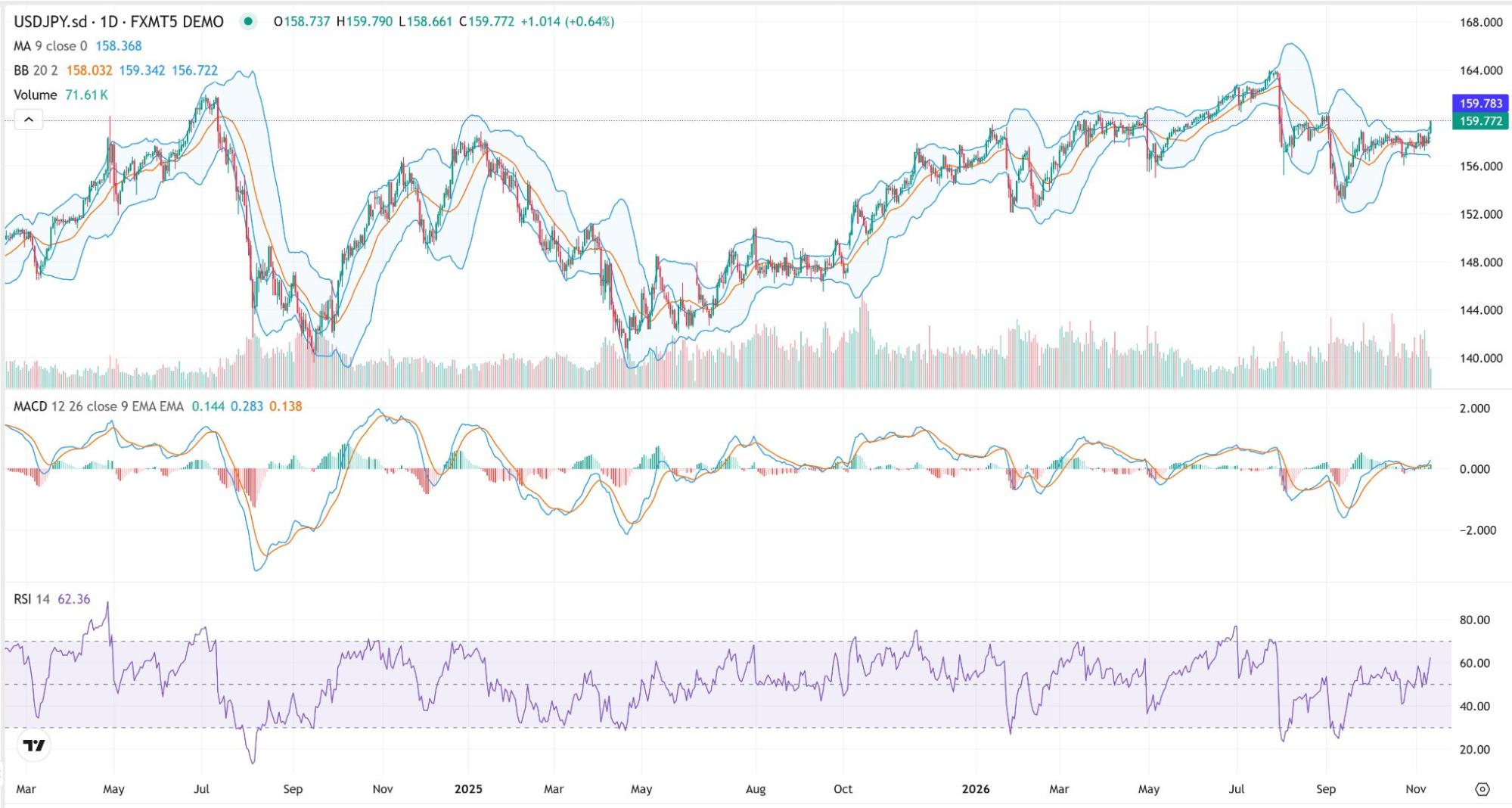
From a technical perspective, USD/JPY has gradually moved beyond its previous consolidation phase, recently reclaiming the important 159.00 level.
The breakout suggests that short-term buying pressure has strengthened, with bullish momentum gaining traction.
The pair has also moved above the upper Bollinger Band at 159.34, indicating relatively strong upward momentum.
However, trading beyond the upper Bollinger Band also suggests that prices have moved away from their recent average, increasing the possibility of a short-term pullback or profit-taking.
On the upside, the first major resistance level to monitor is located near 160.86.
A sustained breakout above this level could open the door to further gains, with the next potential upside target around the psychological 162.00 level.
On the downside, initial support is located near 158.65.
Further support can be found around the 9-day moving average at approximately 158.37, followed by the middle Bollinger Band near 158.03.
As long as USD/JPY remains above the middle Bollinger Band, the broader recovery structure may remain intact.
However, a failure to maintain these support levels could signal weakening momentum and increase the risk of a deeper correction.
Technical Indicators Point to a Moderate Bullish Recovery
Technical indicators are showing signs of improving momentum, although they have yet to confirm a decisive acceleration in the uptrend.
The 9-day moving average currently stands near 158.36 and continues to slope gradually higher.
With USD/JPY trading above this level, the moving average provides a degree of short-term technical support.
The Bollinger Bands show a middle band near 158.03, an upper band around 159.34, and a lower band near 156.72.
The bands have narrowed noticeably compared with earlier periods, indicating that recent market volatility has declined.
The move above the upper band therefore represents an important technical development, bringing the 160.86 resistance area into sharper focus.
Meanwhile, the Moving Average Convergence Divergence (MACD) indicator is beginning to improve.
The MACD and signal lines are turning higher, while the histogram has moved slightly into positive territory.
However, the indicator remains close to the zero line, suggesting that bullish momentum has not yet expanded significantly.
The Relative Strength Index (RSI) has risen to 62.36, placing it in moderately bullish territory.
Importantly, the RSI remains below the conventional overbought threshold of 70, indicating that upward momentum has strengthened without reaching an extreme level.
Taken together, these indicators suggest that USD/JPY is experiencing a moderate bullish recovery.
Nevertheless, a decisive breakout above the next major resistance level will be needed to confirm whether the pair has sufficient momentum to extend its advance.
Conclusion: Fed–BoJ Policy Expectations Remain Central to USD/JPY’s Next Move
Overall, USD/JPY is maintaining a relatively firm technical outlook as persistent US inflation pressures reinforce expectations that the Federal Reserve will keep monetary policy restrictive for longer.
At the same time, growing discussions around faster policy normalisation at the Bank of Japan are providing potential support for the yen.
The evolving monetary policy outlook in the United States and Japan therefore remains a key factor influencing the currency pair.
From a technical perspective, USD/JPY has broken above its previous consolidation range and moved beyond the upper Bollinger Band, suggesting stronger short-term bullish momentum.
The RSI has not yet entered overbought territory, while the MACD is showing early signs of improvement.
However, with prices trading above the upper Bollinger Band, traders should remain mindful of the possibility of short-term profit-taking and corrective moves.
If USD/JPY can achieve a sustained breakout above 160.86, the pair could extend its advance towards the 162.00 level.
Conversely, if upward momentum weakens and the pair falls back below 159.00, the risk of a corrective pullback could increase.
Looking ahead, the next phase of USD/JPY’s movement will likely depend on incoming US inflation data, Federal Reserve policy expectations, the Bank of Japan’s approach to monetary policy normalisation, and developments in Middle East geopolitical tensions.
Whether the pair can maintain its recent breakout and overcome the next major resistance level will be crucial in determining the sustainability of its current upward momentum.
Related Posts