USD/JPY Comes Under Renewed Pressure as Fed–BoJ Policy Expectations Diverge


USD/JPY has come under renewed selling pressure as shifting monetary policy expectations in the United States and Japan increasingly point in opposite directions.
Softer US employment data and easing inflationary pressure have reduced expectations for further Federal Reserve tightening. In Japan, meanwhile, inflation remains above the Bank of Japan’s 2% target, while recent hawkish signals have strengthened expectations for a potential September rate hike.
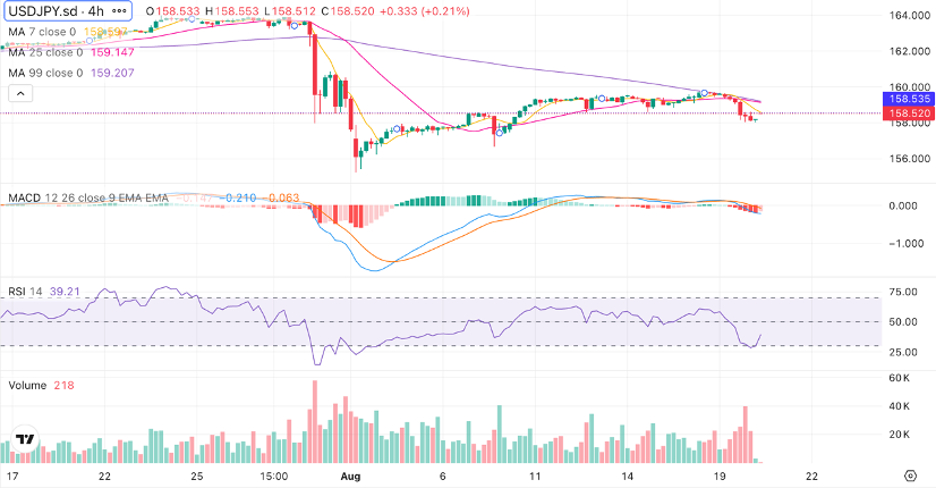
From a technical perspective, USD/JPY has retreated towards 158.20 and fallen below the middle Bollinger Band. The RSI has dropped to 29.08, entering oversold territory, while the MACD has also weakened.
The near-term technical picture therefore remains bearish, although increasingly oversold conditions mean the risk of a technical rebound should not be overlooked.
Key support is currently located around 157.70–158.00, while the major resistance zone sits at 159.80–160.00.
US: Expectations for Further Fed Tightening Ease
US monetary policy expectations are being recalibrated as incoming economic data begins to show signs of moderation.
The July labour market was weaker than expected, while recent inflationary pressures have also eased. Together, these developments have led investors to reduce expectations that the Federal Reserve will continue raising rates in September.
If labour demand cools further, wage growth and services inflation could also begin to moderate, reducing the need for additional monetary tightening.
However, this does not necessarily mean that a rapid shift towards monetary easing is imminent.
Long-term US Treasury yields remain elevated, keeping global long-term financing costs high. Persistent fiscal deficits and continued Treasury supply pressures are also preventing longer-term yields from fully following the change in expectations for monetary policy.
As a result, the market’s focus is gradually shifting away from simply asking whether the Fed will raise rates again. Increasingly, the key questions are how significantly the US economy will slow and how long elevated interest rates can be maintained.
Further weakness in employment and consumption could encourage a more cautious policy stance. However, longer-term inflation and fiscal risks may continue to limit the Fed’s ability to move quickly towards easier monetary policy.
Japan: Policy Normalisation Expectations Build
The policy picture in Japan is moving in a different direction.
Inflation remains persistently above the Bank of Japan’s 2% target, while recent hawkish signals from BoJ officials have reinforced expectations that monetary policy could continue to normalise. Market pricing for a potential September rate hike has consequently increased.
For the BoJ, however, the decision is not simply about inflation.
Policymakers must also consider how Japan’s financial system would respond to higher interest rates. Rising rates would help move monetary policy further away from the ultra-accommodative environment that has defined Japan for years, but tightening too quickly could increase pressure on banks, insurers and holders of long-duration assets.
Fiscal policy adds another layer of complexity.
The Japanese government is considering reducing consumption taxes on certain food products in an effort to ease household living costs. While this could provide some relief to consumers, lower tax revenue could also intensify concerns surrounding fiscal deficits and further debt expansion.
Japan could therefore face an unusual policy combination: tighter monetary policy alongside potentially looser fiscal policy.
This makes the BoJ’s path increasingly complex, with future decisions needing to balance inflation control, economic conditions and financial stability.
Technical Outlook: Sellers Regain the Upper Hand
On the four-hour chart, USD/JPY remains in a weak recovery phase following the sharp decline seen in late July.
The pair previously fell rapidly from above 163.00 towards the 156.00 area. Although it subsequently recovered towards 159.80, the rebound was not strong enough to restore the previous bullish structure.
After consolidating around 159, USD/JPY has begun to weaken again and is now trading near 158.20, having fallen below the middle Bollinger Band. This suggests that sellers have regained the short-term advantage.
The first important support area is located between 157.70 and 158.00.
A sustained break below this zone could open the way for another test of 157.00, followed by the previous low around 156.00.
On the upside, 159.00 represents the first area of resistance should the pair rebound. More importantly, the 159.80–160.00 zone remains the key barrier. A sustained recovery above this area would be needed before the current weak technical structure could meaningfully improve.
RSI Enters Oversold Territory
Momentum indicators continue to favour the downside, although they are also beginning to signal that selling may have become stretched.
The 14-period RSI has fallen to approximately 29.08, placing it within traditionally oversold territory. This reflects the speed and strength of the recent decline and confirms that bearish momentum has intensified.
At the same time, an oversold RSI means traders should be increasingly alert to the possibility of a short-term technical rebound rather than assuming that the decline will continue uninterrupted.
The MACD is also showing signs of weakness, with the indicator turning lower again and the histogram moving around and below the zero line. This suggests that the bullish momentum accumulated during the previous rebound is fading.
The Bollinger Bands reinforce this picture. Price has moved rapidly from around the middle band towards the lower band and is beginning to trade close to it, indicating that near-term selling pressure has yet to meaningfully ease.
Trading volume has also increased during the latest leg lower, suggesting that the move has been accompanied by meaningful market participation.
Taken together, the indicators continue to favour the bears in the short term. However, with the RSI already oversold, the market’s ability to find support around 158.00 will be particularly important.
Key Levels to Watch
| Level | Significance |
| 159.80–160.00 | Major resistance / key level for weakening the bearish structure |
| 159.00 | Initial resistance |
| 158.20 | Current price area referenced in the analysis |
| 157.70–158.00 | Key near-term support |
| 157.00 | Next downside level if support breaks |
| 156.00 | Previous low / deeper downside target |
Outlook
Overall, cooling expectations for further Federal Reserve tightening and rising expectations for Bank of Japan policy normalisation are creating an increasingly bearish fundamental backdrop for USD/JPY. The technical structure also points to renewed short-term selling pressure.
As long as USD/JPY remains unable to reclaim the 159.80–160.00 region, the broader weak structure may persist.
On the downside, 157.70–158.00 is the key area to watch. A decisive break below this support could expose 157.00, followed by the previous low around 156.00.
However, the picture is not entirely one-sided. With the RSI already in oversold territory, the risk of a technical rebound is increasing.
The battle around 158.00 may therefore prove important in determining whether USD/JPY extends its latest decline or enters a short-term recovery phase.
This material is provided for general market information only and does not constitute investment advice. Past performance is not indicative of future results. Trading involves risk.
Related Posts